
Cedar vs Pressure-Treated Fence in Seattle: Which Wood Is Worth It?
Cedar vs pressure-treated fence wood for Seattle's long wet season: rot, posts vs boards, shrinkage, stain timing, fasteners, grades, and the hybrid builds that fit a Puget Sound yard.
A national buying guide will tell you to pick cedar or pressure-treated pine and then build the whole fence out of it. That is the wrong cut for a Seattle yard. Cedar is a species. Pressure treatment is a process, usually applied to a pine that has little decay resistance of its own. They solve different problems, and in a wet maritime climate they belong on different parts of the fence.
The best wood for a fence here is the wood matched to where that piece sits. Western red cedar heartwood is the board you look at. Anything that touches soil, or that stays buried in mulch and leaves, needs a ground-contact treatment or no wood at all.
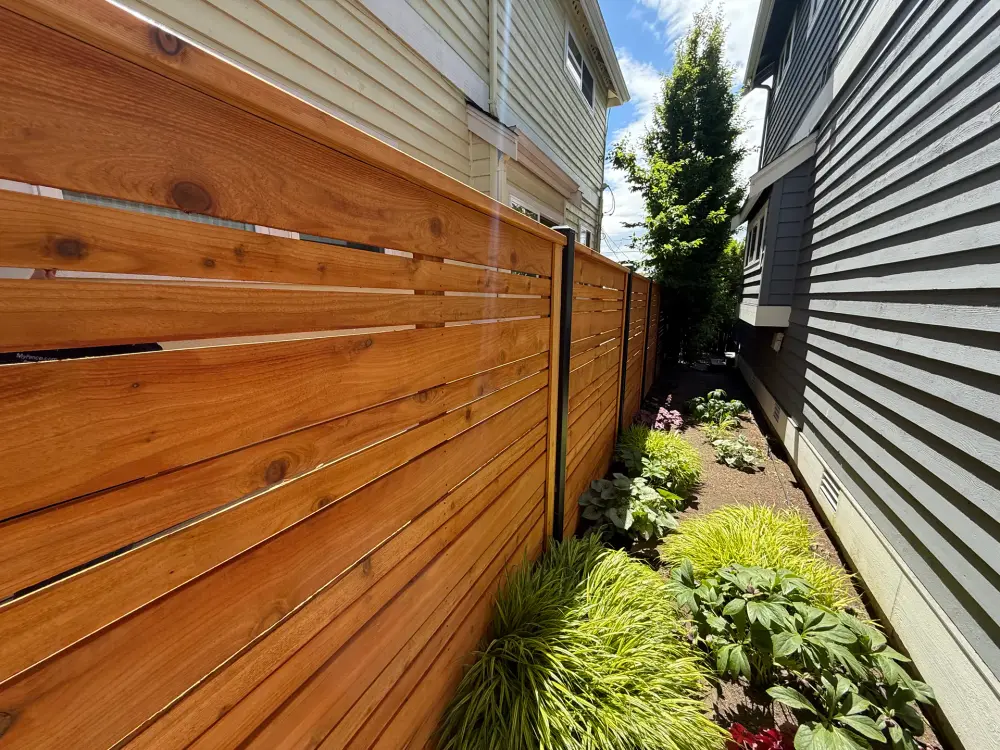
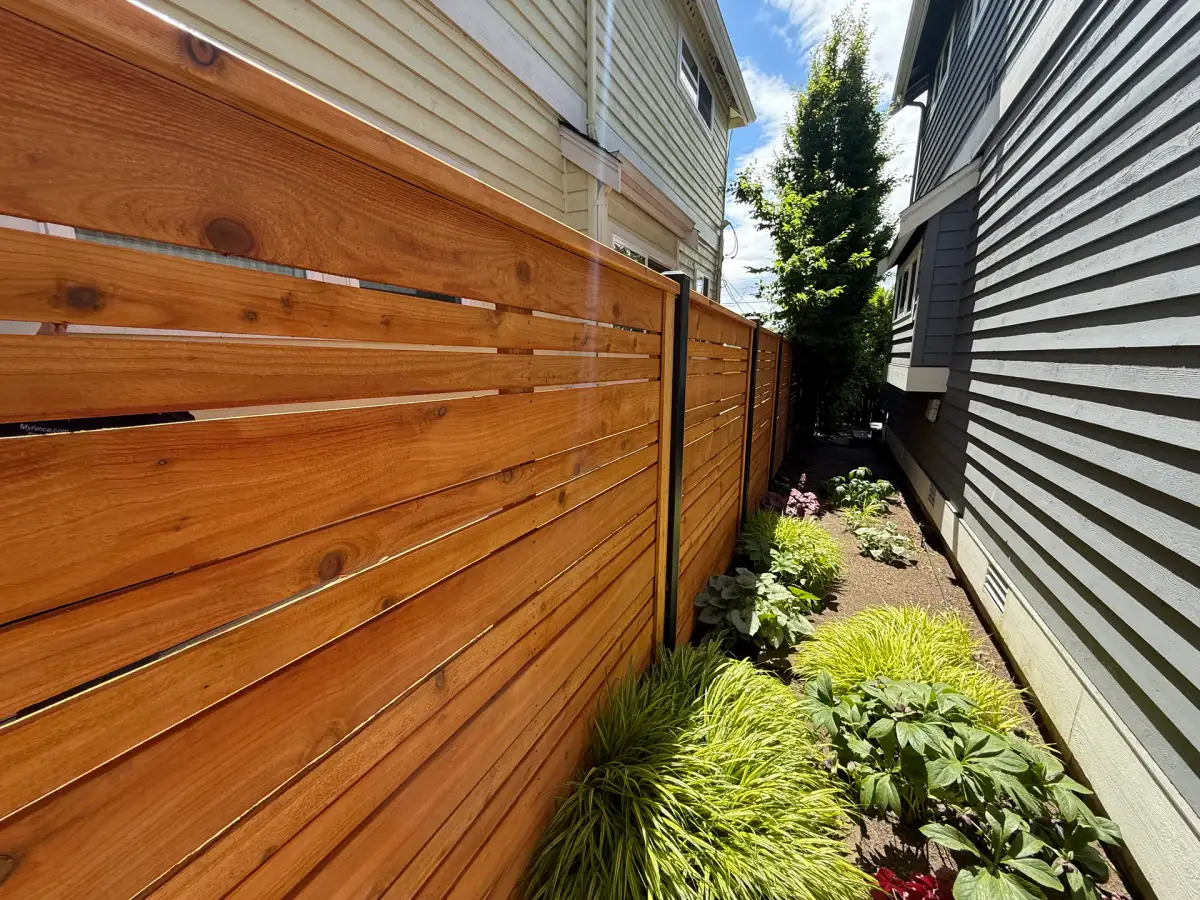
Horizontal cedar in a Ravenna side yard. Flat boards like these show cupping and gaps, which is where cedar's stability earns its place.
In this guide
- The short answer
- Two different kinds of protection
- Why Seattle's wet season changes the choice
- Rot, insects, and the ground line
- Posts versus boards, and the tag on the lumber
- Lifespan, with the sources attached
- Warping, shrinking, checking, and color
- Cedar board grades
- Staining, drying time, and moss
- A maintenance rhythm for the rainy season
- Upfront cost and long-term value
- Hybrids that fit a wet yard
- Fasteners for each wood
- Decision checklist
- FAQ
The short answer
Use the two woods for the jobs they are actually good at.
- Boards, rails, and trim you can see, held off the soil: western red cedar. The heartwood is naturally decay-resistant, and the wood moves less as it dries than the pines used for treated lumber.
- Posts and any wood in the dirt, or wood that will sit in bark, leaves, or splash: lumber stamped for ground contact, or a steel post so there is no wood in the soil at all.
- The usual durable mix in our work: cedar where you look, and a ground-contact board or a steel post where the fence meets the yard.
The one-sentence version
Cedar is worth it for the fence you see. Pressure treatment is worth it for the wood that stays wet. Buying cedar posts to save the look, or treated boards to save the bid, spends the money on the wrong piece.
Two different kinds of protection
Western red cedar (Thuja plicata) resists decay because of extractives in the heartwood. The Western Red Cedar Lumber Association attributes that resistance to naturally occurring fungicidal compounds called thujaplicins, and notes a second extractive, thujic acid, that helps the wood resist insect attack. The same guidance is blunt about the limit: where cedar stays in contact with the ground, it should be treated with a preservative (WRCLA quick facts).
Pressure-treated fence lumber is a different idea. The USDA Forest Products Laboratory's Wood Handbook groups heartwood by how it has held up in service. Western redcedar sits in the resistant group. Most pines other than a few old-growth species sit in the slightly or nonresistant group. Untreated sapwood of essentially every species has low decay resistance. The handbook's practical reading is that resistant heartwood generally gives satisfactory service above ground, while the very resistant group is the one generally expected to perform in ground contact. Species in the lower groups usually need preservative treatment when decay is likely (Wood Handbook, Chapter 14, 2021).
The 2010 handbook's species description calls western redcedar heartwood very resistant to decay. Table 14-1 in the 2021 biodeterioration chapter, the ranking used for service conditions, places it in the resistant group. That gap is the ground-contact warning: very resistant heartwood is the group expected to perform in the dirt, and resistant heartwood is the group expected to perform above ground (2010 handbook).
That is why "cedar vs pressure treated" is an odd comparison. One side is a durable heartwood with a limit at the soil line. The other side is a treatment that exists because the wood underneath is not durable. Both can be the right call. They are not interchangeable parts.
Heartwood is the durable part
A cedar board with a wide band of pale sapwood is not the same material as a heartwood board. The Wood Handbook is clear that untreated sapwood has a short service life when conditions favor decay. If you are paying for cedar, you are paying for heartwood in the pieces you will see.
Why Seattle's wet season changes the choice
Sea-Tac Airport's 1991–2020 climate normals, the long-term record people use for the central Puget Sound, average 39.34 inches of precipitation a year and 156.2 days with at least 0.01 inch. November is the wettest month in that table, at 6.31 inches. July is the driest, at 0.60 inches. From October through April the station averages at least 14 days a month with measurable precipitation. July and August average fewer than five (NOAA NCEI, station USW00024233). Your block will not match the airport exactly. The pattern will: a long stretch of frequent, often light rain, and a short dry summer.
Decay does not start just because the air is damp. The Wood Handbook says serious decay needs wood moisture above the fiber saturation point, about 30 percent on average, and that humid air alone will not wet wood enough for that. It will allow mold. The same handbook puts outdoor wood under cover in the Pacific Northwest near 16 percent moisture, higher than the 12 to 14 percent typical of much of the country (Wood Handbook, Chapter 16, 2021). The water that actually rots a fence is liquid water that cannot leave: soil, splash, a rail crack, a pile of needles.
A USDA Forest Products Laboratory bulletin on yard fences puts the worst decay at the ground line, where soil moisture meets air. It also lists the Pacific coast of Washington and northern Oregon among the regions where decay of above-ground fence parts is greatest (USDA FPL, Protecting Wood Fences for Yard and Garden). That is the local problem in one paragraph. Posts fail where dirt and oxygen meet. Boards and rails fail where water sits and the wood cannot dry for months.
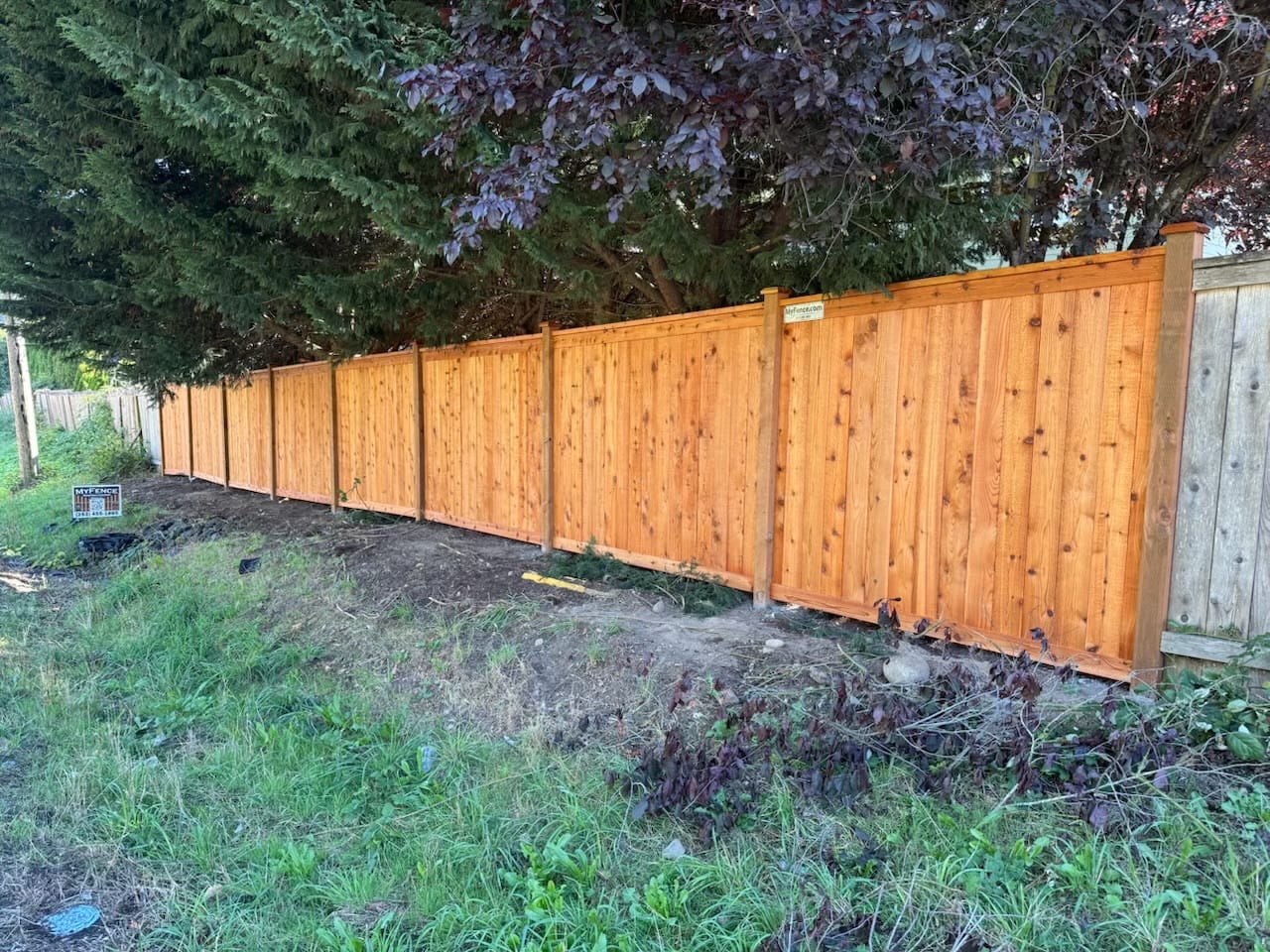
A stained cedar picture-frame fence under evergreen cover in Renton. A shaded line stays wet long after the rain stops.
On a typical lot around Seattle, Ballard, Green Lake, Bellevue, or Kirkland, that shows up as a few repeat conditions:
- North sides and tree cover. Boards under firs and maples may not dry between storms from fall into spring.
- Debris at the base. Moss, leaves, bark, and grass hold water against the bottom board. The USDA bulletin notes that soil against fence boards supplies moisture for decay.
- Slow drainage. The same bulletin says crushed rock can help a post drain in light soil and can hold a pool of water around the post in clay. If your yard stays puddled after a storm, treat the post zone as a wet site.
- Summer water. A sprinkler or a downspout aimed at the fence spends the dry months undoing the only drying season you get.
Our wood fence lifespan guide goes further into how those conditions show up part by part.
Rot, insects, and the ground line
Fungi need moisture and oxygen. The USDA bulletin calls the post the critical link in a fence and names decay as the main reason posts fail. Water also enters the ends of boards and rails much faster than the faces, so end grain at the bottom of a picket, the cut end of a rail, and the top of a post are the usual starting points.
Insects follow the moisture, and the local insects are not the ones a Gulf Coast guide is written around. The USDA bulletin says the danger of underground termite attack is greatest along the Gulf Coast, the South Atlantic, and in Hawaii. In western Washington the insect story is wet wood:
- Pacific dampwood termites need wet or rotting wood. Washington State University describes them as a sign of an existing moisture problem, such as wood-to-soil contact, and notes they do not nest in dry, sound wood (WSU Pestsense). The Pacific Northwest Pest Management Handbooks add that dampwood termites are the species more prevalent in western Washington and Oregon, while the western subterranean termite is more common east of the Cascades (PNW Handbooks).
- Carpenter ants do not eat wood. They excavate it for a nest, often starting in wood that is already soft from decay (WSU Pestsense).
A preservative treatment is built for this exposure. AWPA's Use Category descriptions list decay fungi and insects as the organisms ground-contact and above-ground exterior wood has to resist. The treatment does not replace the construction habits WSU repeats for both termites and carpenter ants: keep wood off the soil, and do not pile debris against it.
Posts versus boards, and the tag on the lumber
The American Wood Protection Association sorts treated wood by exposure, not by species. The categories that matter on a fence:
| Tag | What AWPA is describing | Typical fence piece |
|---|---|---|
| UC3B | Above ground, exposed. Uncoated wood that is not in contact with the ground. | Fence pickets, railings, decking |
| UC4A | Ground contact, general use. Wood in contact with the ground, fresh water, or a similar hazard. Also some above-ground pieces that are hard to replace or that end up in ground-contact conditions. | Sawn fence posts |
| UC4B | Ground contact, heavy duty. Critical pieces, or sites with a higher decay potential. | Posts and poles where replacement is difficult or the exposure is severe |
Those definitions are in AWPA Standard U1. Fence pickets are the example AWPA gives for UC3B. Sawn fence posts are an example it gives for UC4A (AWPA U1 excerpt, and the shorter tag guide for code officials at awpa.com).
U1 also says some sawn pieces that are physically above the dirt still have to be treated to ground-contact levels. The cases that show up on Puget Sound fences: a reasonable expectation that soil, vegetation, or leaf litter will build up and stay there; a piece installed less than six inches above finished grade on a permeable support without a moisture break; and wood that is wetted often. That is a treating specification, not a Seattle building-code citation. It is still the right way to read a shady, mossy fence line. A picket treated only for above-ground use is the wrong board to drop into the dirt.
The USDA bulletin says the same thing in plainer language. Wood used in the ground should be stamped for ground use. Lumber marked for above-ground use only has less preservative and should not be buried.
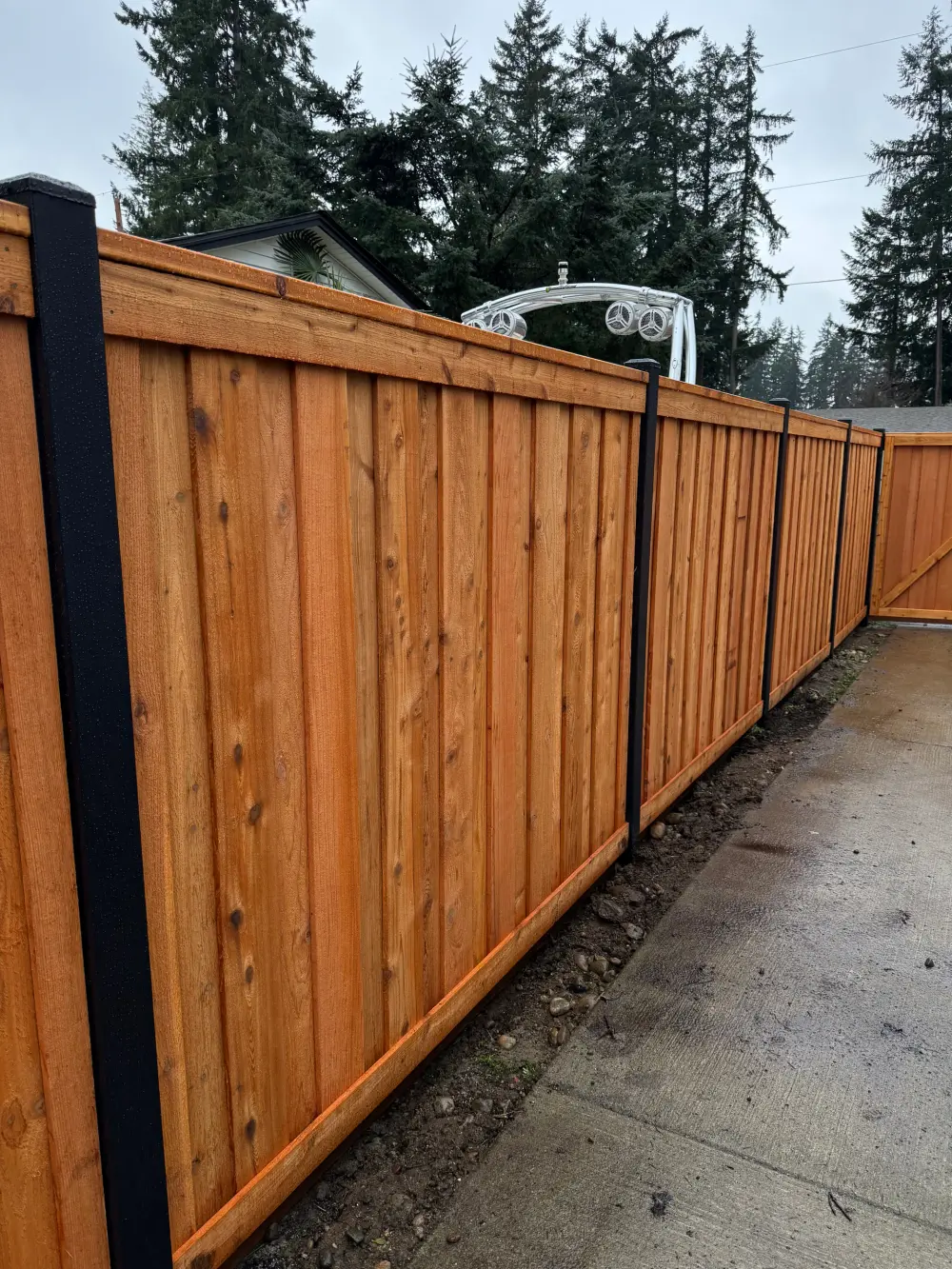
Cedar boards on black steel posts in Wynaco, Kent. The wood you see never has to be the wood in the ground.
When we build for this, the ground-line choice is usually one of these:
- A pressure-treated post stamped for ground contact, with the tag still readable. If the crew cuts the post, the fresh cut needs a field treatment. The American Wood Council's deck guide, written for the same preservative-treated wood, calls for treating cuts with an approved preservative such as copper naphthenate (AWC DCA 6).
- A rot board: a pressure-treated 2x4 along the bottom so the cedar stays off the soil. If the bottom of the fence lives in mulch, that is the piece that should be treated for the exposure, not the cedar face.
- No wood in the soil. Steel posts, post on pipe, or cedar post on pipe. More on those below.
Lifespan, with the sources attached
Anyone who gives you one number for "a wood fence" is averaging a board in the air with a post in the mud. These are the ranges we can tie to a named public source. They are not a promise for your yard.
| Piece | Published range | What the source actually measured |
|---|---|---|
| Cedar fencing in the Northwest | 15 to 30 years | Seattle Times fence-care guide. It notes that panels usually outlast posts because panels should not touch the ground. |
| Untreated split western redcedar posts | 8 to 24 years | USDA FPL fence bulletin, "depending on climate." |
| Untreated pine posts | About 3 years in the South, 6 to 12 years in the dry West | Same USDA bulletin. It does not publish a western Washington figure for untreated pine. |
| Pine posts treated for ground contact | 30 to 40 years | Same USDA bulletin. The figure comes from Forest Products Laboratory field tests in southern Mississippi, and the bulletin was published in 1979. |
Read the date and the test plot
The treated-post range is the clearest public research number we have, and it is also easy to misuse. It is a 1979 bulletin, the plots were in southern Mississippi, and the preservatives in use then are not the copper systems sold for residential lumber now. The Wood Handbook still says modern copper-based treatments are what protect low-resistance species outdoors. No table in this article is a lifespan we are guaranteeing.
What the pattern is good for: treatment beats species underground, and species plus dryness wins above ground. A cedar board can be in the middle of a long life while a cedar post at grade is already soft. A ground-contact post can outlast the boards on it. The build decides which of those stories you get. Drainage, shade, fasteners, and whether the bottom of the fence is buried in bark move you inside those ranges more than the calendar does.
The Seattle Times guide is here: How to keep your wood fence looking beautiful. The USDA bulletin is here: Protecting Wood Fences for Yard and Garden.
Warping, shrinking, checking, and color
Cedar's other advantage is that it moves less. The Wood Handbook publishes shrinkage from green to ovendry for small, clear specimens. These are laboratory figures, not a prediction of the gap that will open between your pickets. They do show which wood is more willing to change size.
| Species | Radial | Tangential | Volumetric |
|---|---|---|---|
| Western redcedar | 2.4% | 5.0% | 6.8% |
| Loblolly pine | 4.8% | 7.4% | 12.3% |
Loblolly is a common member of the southern pine group used for treated lumber. Tangential shrinkage, the movement around the growth rings, is what cups a board. Western redcedar's volumetric shrinkage is a little over half of loblolly's (Wood Handbook, Chapter 4). The WRCLA describes the same trait from the mill side: a low shrinkage factor and strong resistance to warping, twisting, and checking, with the caveat that cedar in prolonged ground contact should still be preservative-treated (WRCLA quick facts).
Treated pine adds a timing problem. Waterborne treatment leaves the wood wet. The Wood Handbook says preservative-treated lumber is sometimes still above saturation when it is delivered, heavy enough that water will come out of a sliver if you squeeze it, and that nothing coats wood in that condition well. As that water leaves, the board shrinks, and a higher-shrinkage species shows it. Boards fastened tight while they are wet can open gaps, cup, and check the following summer. Kiln-dried-after-treatment lumber, sold as KDAT, is the version dried at the plant before you build (Wood Handbook, Chapter 16).
That movement is why the style matters:
- A horizontal fence puts the wide face of every board in view. Cup and twist read as the whole design.
- A picture-frame fence or solid board fence still shows gaps if the pickets shrink after they are nailed edge to edge.
- Board-on-board overlaps the edges, so a little shrinkage does not open a sightline the way a tight butt joint does.
Fresh cedar is a warm red-brown. Left unfinished, ultraviolet light breaks down the surface and the wood goes gray. Treated lumber's fresh color is the treatment. The Wood Handbook notes that copper-based treatments can hold a brown tone for a while; either wood weathers if you leave it bare. If the color is the reason you wanted cedar, the finish plan is part of the purchase, not an optional extra. For how posts themselves twist as they dry, see why wood fence posts warp.
Cedar board grades
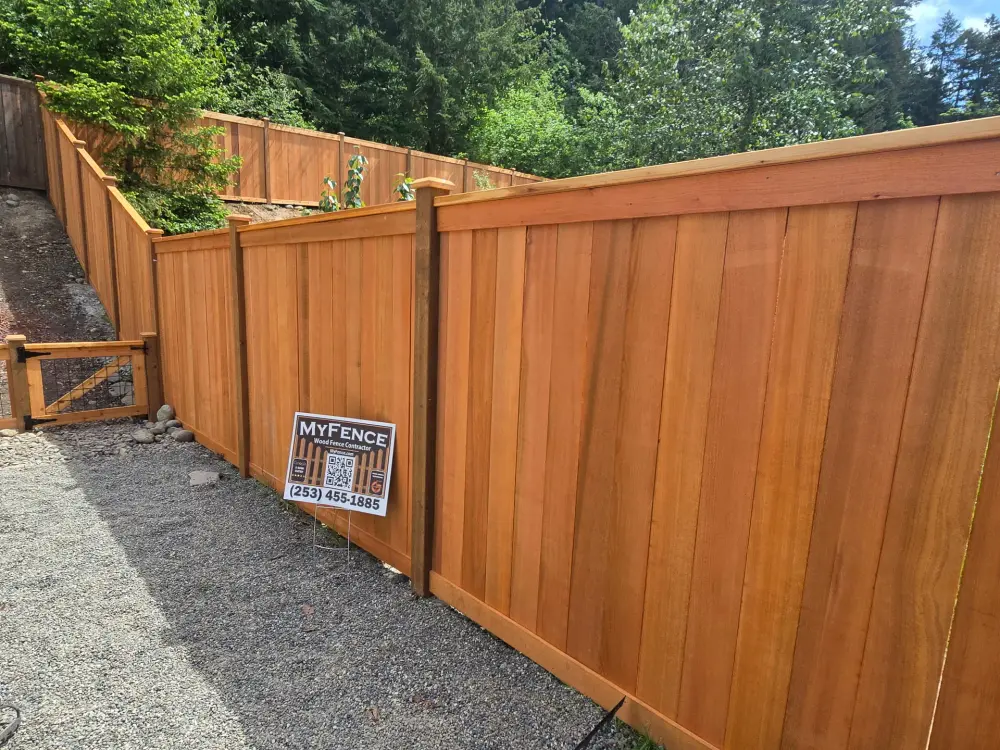
A clear-cedar picture-frame fence in Bonney Lake. The face is uniform. The posts are still wood, and they are still the pieces that meet the ground.
Grade is about the face of the board, not a second kind of rot resistance. Our cedar board grade guide walks through the options we actually stock:
- 1x6 #1 & Better for a standard privacy fence. Tight knots and some color variation, with a solid board.
- 1x4 #1–2 face where a pattern needs the narrower width.
- Clear cedar in 1x4 and 1x6 when you want a face that is nearly free of knots. There is a clear cedar upgrade page for that option.
Knots are not just a look. A knot that loosens becomes a hole, and a hole is a place water gets in. The Wood Handbook also flags knots and cracks as the kind of defect that gives a finish something to fail around. Clear stock avoids that. It does not change the rule about the post. A clear cedar board on an untreated post in wet soil is still a fence that will fail at the ground line.
Heartwood versus sapwood matters more than the knot grade for decay. Ask for heartwood on the face you will see, and do not expect a sapwood edge to behave like the red heart next to it.
Staining, drying time, and moss
A finish is how you keep the color and slow the wetting. It is not a substitute for the right post.
The WRCLA's finishing guidance says coating cedar above 20 percent moisture content raises the chance the finish fails, and that the practical target in North America is roughly the moisture content the wood will live at, about 12 percent, with kiln-dried cedar the better product to start from. It also prefers solvent-borne oil stains when you want the finish to penetrate, and it warns that clear finishes have a short life in full sun and weather (WRCLA, How to Finish). In this climate the Wood Handbook's outdoor figure is higher, near 16 percent under cover, so "dry enough" is a real measurement, not a date on the calendar.
Pressure-treated wood has its own clock. The 2021 Wood Handbook says waterborne copper treatments can be painted or stained once the wood is clean and dry, and that about a week is often enough for the surface to dry. It also says lumber that is still saturated will not take a coating, and the remedy is to wait or to buy KDAT. A week of drying weather is a normal assumption in a lot of the country. It is not a normal week in Seattle from October through April. Stain that goes on wet wood peels, and then the wood is bare for the rest of the rainy season.
Dry wood, then finish
If a treated board is still heavy, or water beads and sits, it is not ready. If you want the cedar coated on the back, the edges, and the top of the rails, do that before the fence is standing in the rain. That is what pre-staining is for.
We stain cedar components before they go up so the faces you cannot reach later still get coverage. The details are on the pre-staining page. For product types and what holds up here, see fence treatments for Seattle's climate and the fence staining guide. That staining guide recommends planning on a new coat about every 3 to 4 years in this wet climate. The step-by-step is in how to stain a fence.
Moss and mildew are a surface problem that becomes a moisture problem. The Wood Handbook notes that humid air can support mold even when the wood is not wet enough for decay. A moss mat on the bottom board holds the next rain against the wood. Wash that off before you stain. How to clean a fence before staining covers the prep.
A maintenance rhythm for the rainy season
| When | What to do | Why it matters here |
|---|---|---|
| Early fall | Pull soil, bark, and last year's needles off the base. Trim plants back. | October is when the wet stretch starts. |
| After winter wind | Push on posts and swing the gates. | A soft post shows up as lean before it breaks. |
| Late spring | Rinse moss and mildew. Look for black streaks at nail heads. | You can see the wood again, and you can still schedule stain work in summer. |
| Mid-summer | Point sprinklers and downspouts off the fence. | This is the drying window. |
| Every few dry summers | Re-stain cedar that you want to keep colored. | The staining guide's local cycle is about 3 to 4 years. |
New landscaping is the usual way a good fence gets shortened. A fresh layer of bark piled over the rot board, or over the base of a steel post's wood trim, puts the cedar back in contact with a wet sponge.
Upfront cost and long-term value
Cedar is the board people price when they want the look, and treated pine is the board people price when they want the lower material bill. How wide that gap is depends on grade, width, and the week you buy. A Ravenna side yard and a long Maple Valley line are not the same job, so this article does not put a percent or a per-foot figure on it. The 2026 wood fence material outlook is the budgeting piece. The price for your line comes from a quote.
What the cedar premium actually buys, when you spend it on boards:
- A face that stays flatter as it dries.
- Heartwood decay resistance above ground, without relying on a treatment for that part.
- A color most people chose cedar for in the first place, if they keep a finish on it.
What it does not buy:
- A longer fence, if the posts are untreated cedar in wet soil. The Wood Handbook puts resistant species in the above-ground category, and the USDA post ranges are much wider for cedar in the ground than people expect from the boards.
- A finish you can skip. Unfinished cedar still goes gray. The oils do not keep the color.
- Lower maintenance at the ground line. Moss, mulch, and sprinklers do not care what species the bottom board is.
The money that changes the life of the fence is usually the post, the fastener, and the bottom detail, not a upgrade from a good cedar board to a slightly nicer cedar board. Clear cedar is worth it when you will see the face every day and you want fewer knots. It is a poor trade if the bid cut the post specification to pay for it.
One limit on our side, so it is not confused with a wood lifespan: MyFence.com's published warranty is a 36-month workmanship warranty on the installation. It covers how the fence was built. It is not a numbered life for cedar, treated pine, or any other material.
Hybrids that fit a wet yard
You do not have to choose one wood for every piece. These are the combinations we build because of the exposure above, not because a catalog said to mix materials.
Cedar boards, ground-contact posts
Cedar pickets and rails, posts stamped UC4A or the heavier UC4B where the yard stays wet, and a rot board if the grade wants the fence close to the soil. You get the cedar face. The buried wood is the wood that was treated to be buried. Read the tag before the post goes in the hole.
Cedar on steel posts
Black steel posts take the rot location out of the fence. The posts page describes powder-coated 4x4 posts with polyester or super-durable polyester coatings, often meeting AAMA 2604 or 2605. Cedar rails and boards attach above grade. Post on pipe is the version that keeps a wood post: a galvanized pipe goes in the concrete and the wood starts above the soil. Cedar post on pipe is that same idea when you want the post to match the boards.
Cedar frame, steel panels
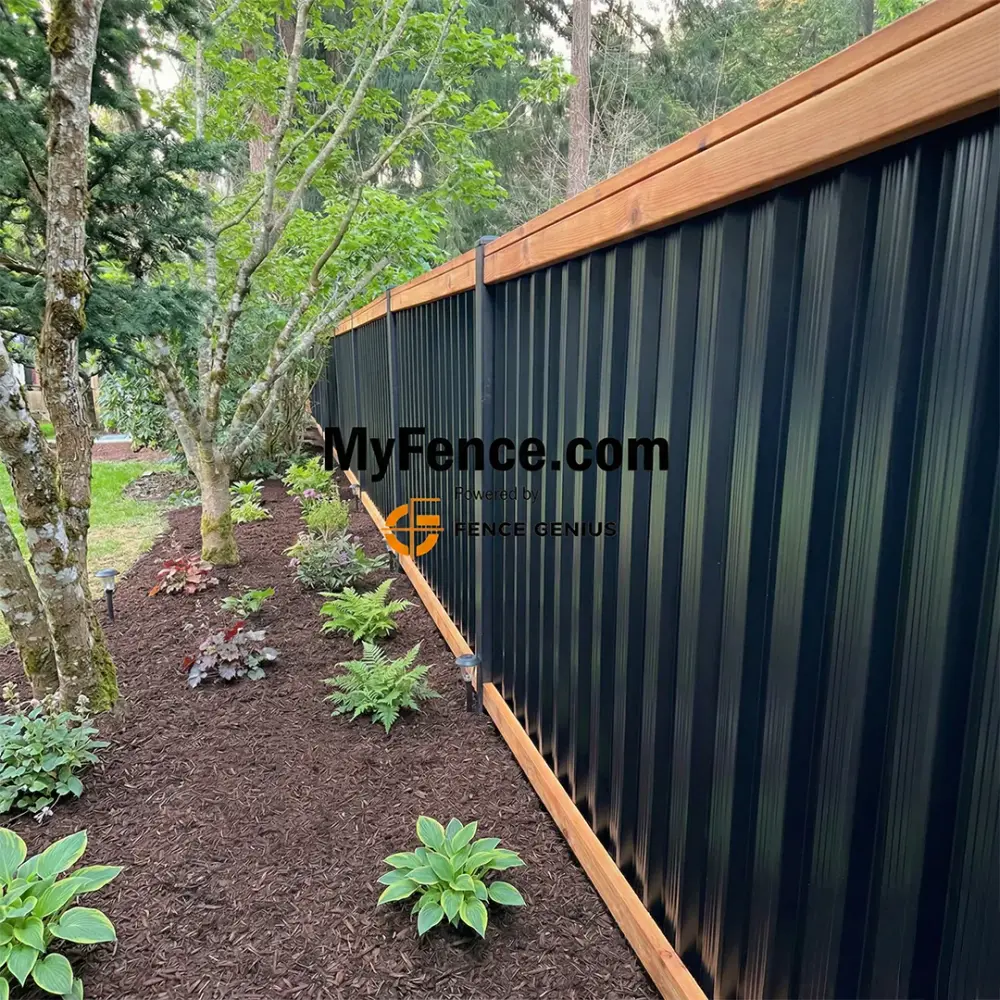
Corrugated steel panels in a cedar frame at Daybreak at River Ridge in Maple Valley. The steel is the privacy face. The cedar trim still has to stay out of the mulch.
A cedar-steel hybrid fence uses corrugated steel panels for the privacy face and cedar for the frame. Less wood is asked to shed a Seattle winter. The cedar that remains is still wood: keep bark off the bottom rail, and finish the cedar if you want to hold the color.
Gates are the place these choices get tested. A gate is a moving load on one post. The post specification matters more there than anywhere else on the line. How we build gates covers the hardware side.
Fasteners for each wood
Both woods punish plain steel. They do it for different reasons, so "galvanized" on the invoice is not a complete answer.
Treated wood is corrosive to ordinary metal. Residential treatment shifted to copper-based systems after CCA left most residential uses. The Wood Handbook notes CCA was commonly available in the United States until 2004, and that today's residential treatments are waterborne copper systems. The American Wood Council's fastener FAQ says those copper systems, including ACQ and copper azole, have shown themselves more corrosive to metal than CCA, and that common electro-galvanized coatings are often too thin. The recommendation there is corrosion resistance at least equal to hot-dip galvanizing, with Type 304 or 316 stainless where you want the higher resistance. Do not mix galvanized and stainless in the same connection. The zinc sacrifices itself to the stainless (AWC fastener corrosion FAQ).
The building-code language matches that. IRC R317.3 calls for hot-dipped galvanized steel, stainless steel, silicon bronze, or copper fasteners in preservative-treated wood, and the stainless requirement for staples was tightened in the 2018 code discussion (ICC R317.3).
Cedar stains the metal, and the stain runs down the board. Tannins in the wood react with ordinary steel and with thin zinc coatings. The USDA fence bulletin says iron nails rust quickly and leave a brown or black discoloration, and it recommends corrosion-resistant nails such as aluminum or stainless steel, especially if the fence will be finished. We use stainless ring-shank nails and staples on cedar boards and mesh for that reason. The full comparison is in stainless vs galvanized fasteners for cedar fences.
Those nails are not the rail screws. Attaching rails to posts with 4-inch exterior screws is a separate upgrade. If a quote says "upgraded fasteners," ask which pieces, and what alloy.
Decision checklist
Walk the line before you pick a wood. The answers change from one side of the house to the other.
- Will this piece touch soil, mulch, or a pile of leaves? Ground-contact treated wood, or steel. Not untreated cedar.
- Is this the face you see from the kitchen or the street? Spend the cedar budget here.
- Is the run shaded, north-facing, under evergreens, or in a low spot? Put the money into the post and the bottom detail before you upgrade every board.
- Do you want the cedar color to stay? Plan the finish, and do not coat wood that is still wet. Pre-staining covers the hidden faces.
- Is the style horizontal, picture frame, or tight vertical boards? Lower shrinkage matters more when the gaps will show. Board-on-board hides a little movement.
- Clear cedar or a knotty grade? Use the grade guide. Do not buy clear boards and a UC3B post.
- What is in the nail gun? Stainless on cedar faces. Hot-dip galvanized or stainless in treated wood. Not electro-galvanized, not bright steel.
- Can you read the post tag? Above-ground lumber is the wrong post. If the post was cut, the cut end needs preservative.
- Are you inside Seattle city limits? Wood choice and fence location are separate. Height and street distance are covered in Seattle fence setbacks.
| If this is your yard | Lean this way |
|---|---|
| You see the fence every day and you want it to stay flat | Cedar boards, and a finish plan |
| The fence is mostly a back line nobody studies | Treated boards are a reasonable save, if the posts are still right |
| The base stays mossy, shaded, or buried in bark | Steel posts or post on pipe, plus a way to keep soil off the wood |
| You want cedar posts for the look | Cedar post on pipe, so the cedar starts above grade |
| You want less wood in the weather entirely | Cedar-steel hybrid |
| The gate gets used daily | The same post rule, with more attention. See the gate build |
The mix we build most often on a wet lot
Cedar boards and rails, held off the ground, on steel posts or on ground-contact wood, with stainless fasteners in the cedar and a finish applied when the wood is actually dry. Style options start on the fence styles page. If you want to see the line on your own lot first, Fence Genius is the planning step before the quote.
FAQ
Is cedar or pressure-treated wood better for a Seattle fence?
For the boards, western red cedar. For anything in the ground, pressure-treated wood stamped for ground contact, or a steel post. A fence that is all one or all the other spends money on the piece that did not need it and under-builds the piece that fails first.
Can I use cedar posts?
You can. The WRCLA says cedar in prolonged ground contact should be preservative-treated, and the USDA bulletin's range for untreated split western redcedar posts is 8 to 24 years depending on climate. In a yard that stays wet, we would rather put the cedar above grade, on a steel post or on a pipe.
What does UC4A mean?
It is an AWPA use category: ground contact, general use. Sawn fence posts are one of the examples in the standard. UC3B is the above-ground category used for pickets. UC4B is the heavier ground-contact category. The tag should match the hole you are putting the wood in (AWPA).
Why do treated boards warp more than cedar?
Southern pine shrinks more than western redcedar as it dries, and waterborne treatment often leaves the lumber wet. The Wood Handbook's green-to-ovendry figures are 6.8 percent volumetric for western redcedar and 12.3 percent for loblolly pine. Boards nailed tight while they are wet open up as they season. KDAT lumber is dried after treatment if you want less of that movement.
How long do I wait to stain in Seattle?
Wait until the wood is dry, not until a fixed number of weeks has passed. The WRCLA says not to finish cedar above 20 percent moisture. The Forest Products Lab says a week often dries the surface of waterborne-treated wood, and that saturated lumber will not hold a coating at all. From October through April, Sea-Tac averages more than 14 days of measurable precipitation a month, so "next weekend" is not a drying plan. Pre-staining moves that work indoors, before the fence is up.
Do I need special nails?
Yes. Copper-treated wood needs hot-dip galvanized or stainless fasteners, not a thin electro-galvanized coating (AWC). Cedar needs a fastener that will not react with its tannins and streak the board. We use stainless ring-shank nails and staples on the cedar. The longer explanation is the fastener guide.
Is cedar worth the higher price?
On the boards you see, and on styles where flatness shows, yes. As a post in wet soil, you are paying a premium for the job the wood is worse at. Put the premium on heartwood boards, a real ground-contact or steel post, and fasteners that will not stain or corrode. Get the installed number from a quote rather than a national per-foot average.
Will a steel post still look like a wood fence?
The posts are dark and the boards are cedar, which is the Wynaco fence higher up this page. If you want the post itself to be cedar, cedar post on pipe keeps that look with the buried piece in steel. If you want the panels in steel too, that is the cedar-steel hybrid.
Talk through the wood for your yard
MyFence builds these fences across the Puget Sound, including Seattle, Bellevue, Kirkland, Renton, Kent, and Maple Valley. Tell us which sides of the house stay wet, which sides you look at, and whether the posts can be steel. We will match the wood to the exposure.
Get a quote or call (253) 455-1885.
Sources
- NOAA National Centers for Environmental Information, 1991–2020 monthly normals, Seattle-Tacoma International Airport, station USW00024233 (data table)
- USDA Forest Products Laboratory, Wood Handbook, 2010, species description of western redcedar (FPL-GTR-190)
- USDA Forest Products Laboratory, Wood Handbook, Chapter 4, shrinkage of domestic woods (FPL-GTR-190)
- USDA Forest Products Laboratory, Wood Handbook, Chapter 14, decay resistance groupings, 2021 (FPL-GTR-282)
- USDA Forest Products Laboratory, Wood Handbook, Chapter 16, finishing and treated-wood moisture, 2021 (FPL-GTR-282)
- USDA Forest Products Laboratory, Protecting Wood Fences for Yard and Garden (De Groot, Feist, Eslyn, Gjovik, 1979)
- Western Red Cedar Lumber Association, quick facts and How to Finish
- American Wood Protection Association, Use Category tag guide and U1 excerpt
- American Wood Council, fastener corrosion FAQ
- ICC, R317.3 fasteners in treated wood
- Washington State University Pestsense, termites and carpenter ants
- Pacific Northwest Pest Management Handbooks, wood-infesting termites
- The Seattle Times, How to keep your wood fence looking beautiful