
Building a Cedar Privacy Fence Around Big Trees: A Wooded-Lot Guide for King County
How to plan a cedar privacy fence on a wooded King County or Eastside lot without wrecking the trees you bought the house for: root zones, utility locates, permits and buffers, post placement, and why pre-stained, pre-built panels suit shady yards.
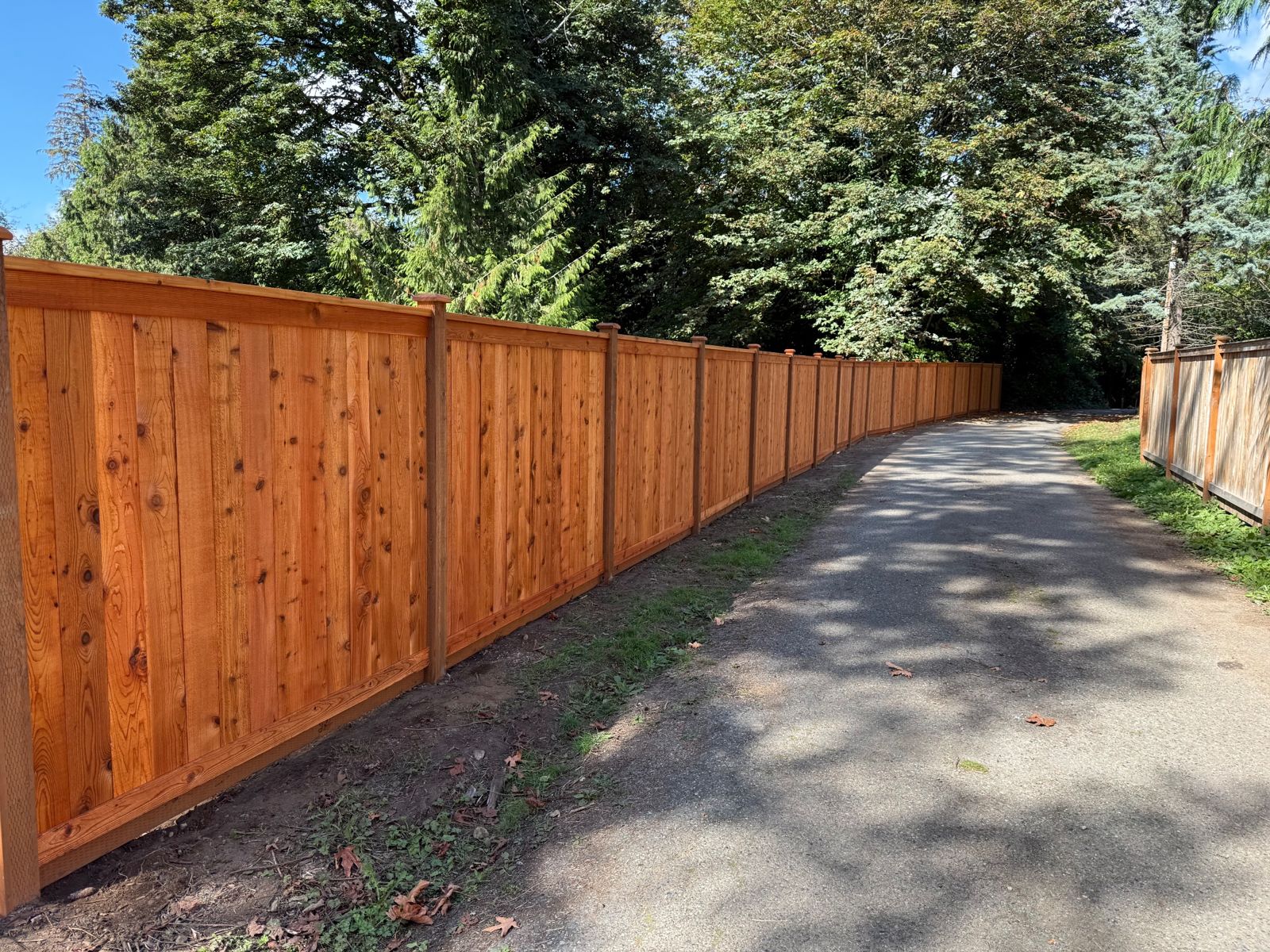
Big firs, cedars and maples are a big part of why people buy on the Eastside and in South King County. They're also the hardest thing to plan a privacy fence around. A careless post hole can cut the roots that hold a tree up, and a fence tucked under a dense canopy stays wet much longer than one in full sun. This guide covers how to plan a cedar privacy fence on a wooded lot so the fence lasts and the trees stay healthy.

A MyFence cedar privacy fence along a tree-lined drive in Maple Valley. Long runs under tall evergreens are common across South King County.
In this guide
- Why trees change the fence plan
- Where tree roots actually are
- Before anyone digs: locates, permits and buffers
- Laying out a fence line around trees
- Shade, needles and moisture
- Why pre-stained, pre-built cedar suits wooded lots
- Local examples: Mirrormont, Central Houghton and East Hill
- A wooded-lot fence checklist
- FAQ
Why trees change the fence plan
On an open lot, a fence line is mostly about property lines, gates and grade. On a wooded lot, three more things come into play:
- Roots. Every post hole on a fence line is a small excavation. Near a large tree, it can land right on roots that feed and anchor it.
- Moisture. Shade and leaf litter keep wood wet. Decay fungi need moisture, and research from the USDA Forest Products Laboratory names decay as the main reason fence posts fail (USDA FPL).
- Rules. Wooded backyards often border buffers, slopes or other areas where local rules or a neighborhood association have a say in what gets built.
None of this means you can't have a solid cedar privacy fence among big trees. It means the layout deserves more thought than "string a line and dig every eight feet."
The short version
Find out where the roots and buried lines are before you pick post locations. Let the fence bend around the tree instead of going through its roots. Then choose materials that cope with shade and damp.
Where tree roots actually are
A tree's roots aren't a mirror image of its crown, and most of them aren't deep. Iowa State University Extension says most roots, especially those that take up water and nutrients, are in the upper 6 to 18 inches of soil, and that structural roots can reach more than four times the dripline of the tree (Iowa State University Extension).
Two consequences for a fence:
- The dripline isn't a safe boundary. Roots run well past the edge of the canopy, so a fence line 10 feet from the trunk can still cross plenty of them.
- The damage may not show for years. Iowa State's forestry extension notes that root and soil damage from construction may not be evident for as long as 8 to 10 years (Iowa State University Extension, Trees and Construction).
The good news is that fences are built on posts, not continuous footings. The same Iowa State guidance suggests building structures on posts rather than footings or extensive foundations where possible, and using hand equipment instead of large machinery in root zones. A post-and-panel fence fits that advice when post holes are placed with care.
Hire an arborist when it matters
If a fence line has to pass close to a large or valuable tree, or you're unsure whether a root is structural, ask an ISA Certified Arborist before anyone digs. It's a small step compared with losing, or having to remove, a mature tree.
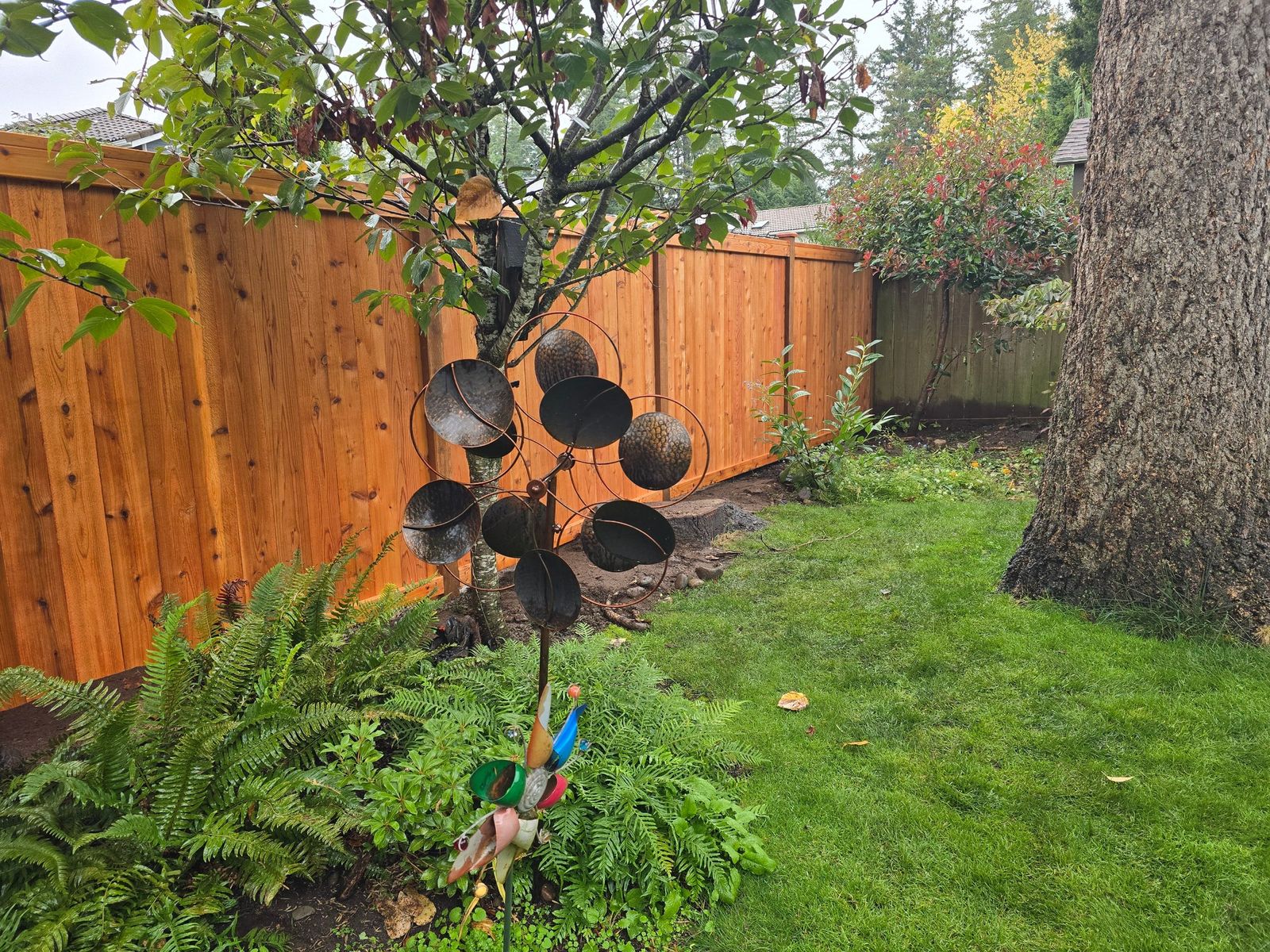
A Maple Valley backyard where the fence line stays clear of a large trunk. The space between them leaves room for both the roots and the tree's growth.
Before anyone digs: locates, permits and buffers
Call 811 for a utility locate
Washington's dig law (RCW 19.122) applies to homeowners. The Washington Utilities and Transportation Commission says to call 811 or request a locate online at least two business days before digging, not counting weekends and holidays, and to outline the dig area in white paint first (WA UTC). Homeowners on noncommercial property are exempt only when digging less than 12 inches (WA UTC), and fence post holes generally go deeper than that.
Utility locators won't mark private lines. The UTC lists examples like power to an outbuilding, invisible pet fences and septic systems. On wooded lots with sheds, shops or long driveways, think about what you or a past owner may have buried, and hire a private locator if needed.
Check permits and protected areas
Rules depend on where your lot is:
- Unincorporated King County (Mirrormont, for example): King County says fences 6 feet high or less don't need a building permit unless the property contains critical areas. It lists steep slopes and wetlands among the special conditions that may require permits. It also says removing a tree that is a hazard, but not an imminent one, requires documentation by a certified arborist and a clearing permit (King County Permitting).
- Kirkland: The city's fence handout says fences may not go in a stream, a wetland, their buffers, or a Native Growth Protection Easement (City of Kirkland fence requirements). We walk through this on our Central Houghton page.
- Other cities: Check your city's fence and tree rules before you plan to remove or cut back a tree for a fence line.
Check with your HOA
If you live in a community with a homeowners association, check with your HOA's architectural review committee before you build. For example, the Mirrormont Community Association's FAQ asks owners to contact the architectural committee before installing a new fence or significantly altering landscaping that may affect their buffer (Mirrormont Community Association). Rules vary by association, so read your own documents. MyFence can prepare the drawing and materials list for your application.
Laying out a fence line around trees
This is where wooded-lot fences succeed or fail. Here's how we approach it.
Let the fence bend, not the tree
A fence line doesn't have to be one straight run. Where a trunk sits on or near the line, we usually:
- Jog the line around the tree with a short offset section, or
- End a run on each side of the tree and leave a planned gap that the tree fills visually.
Either way, avoid fastening anything to a living tree. Trunks keep growing, so leave room between the trunk and the nearest panel.
Move posts, not roots
Panel widths can flex. When a post location lands on a big root, the better fix is usually to shorten or lengthen the bay so the post moves, rather than cutting through the root. Near large roots, we hand-dig post holes and adjust post spacing so the fence line works around the tree.
Keep heavy equipment out of the root zone
Soil compaction is its own form of root damage, and Iowa State lists machinery, stockpiled soil and material storage among the activities that harm root zones (Iowa State University Extension). Plan where panels and materials get staged so they don't sit for days on top of the roots you're trying to protect.
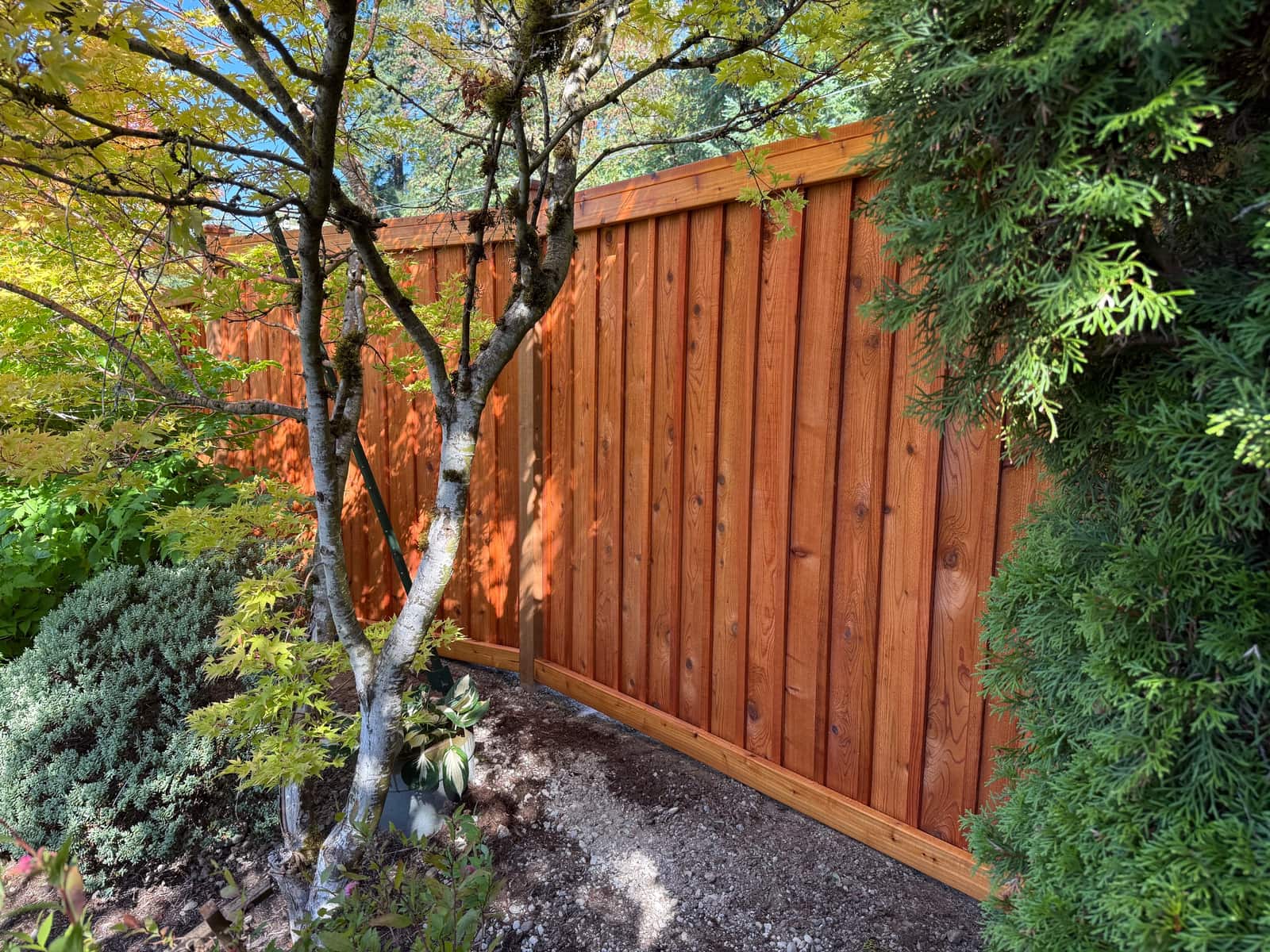
A Renton fence fitted between an ornamental tree and a mature evergreen. The plantings stay, and the fence works around them.
Shade, needles and moisture
Fences under a canopy have a harder life than fences in the sun. The USDA bulletin explains that decay is worst at the ground line, where moisture meets air. It also lists the Pacific coast of Washington and northern Oregon among the regions where decay of above-ground fence parts is greatest (USDA FPL).
Under trees, a few things make that worse:
- Slow drying. Shaded runs stay damp long after a storm passes.
- Needle and leaf build-up. Debris piles up along the base and holds water against the bottom boards.
- Moss. Shady, damp wood grows moss, which also holds moisture.
The Seattle Times' fence-care guide notes that fence panels shouldn't touch the ground (The Seattle Times). On a wooded lot, that clearance matters even more. Options worth discussing on your estimate include a rot board along the bottom, steel posts or post on pipe to keep wood out of the soil, and mounded concrete to shed water away from the post.
Easy upkeep for shady fences
Once or twice a year, rake needles and leaves away from the fence base and keep soil, mulch and bark from piling up against the boards. It costs nothing and keeps the bottom of the fence able to dry.
Why pre-stained, pre-built cedar suits wooded lots
MyFence's pre-staining process dries and culls cedar in the shop, then stains all six sides of each uncut component before assembly, including surfaces that end up hidden once the fence is built. On a shady lot, those hidden faces matter. The back of a board pressed against a laurel hedge, or the top of a rail under a dripping fir, is exactly where water sits. And once the fence is up, it's almost impossible to stain.
Pre-built panels help in a different way. We measure the property with Fence Genius and build panels off-site, so there's less cutting and finishing work in your yard and on-site time stays short. That's useful when the work area is a narrow strip between a house and a stand of trees. Staining in the shop also means no stain overspray or drips on the beds, ferns and moss under your trees.
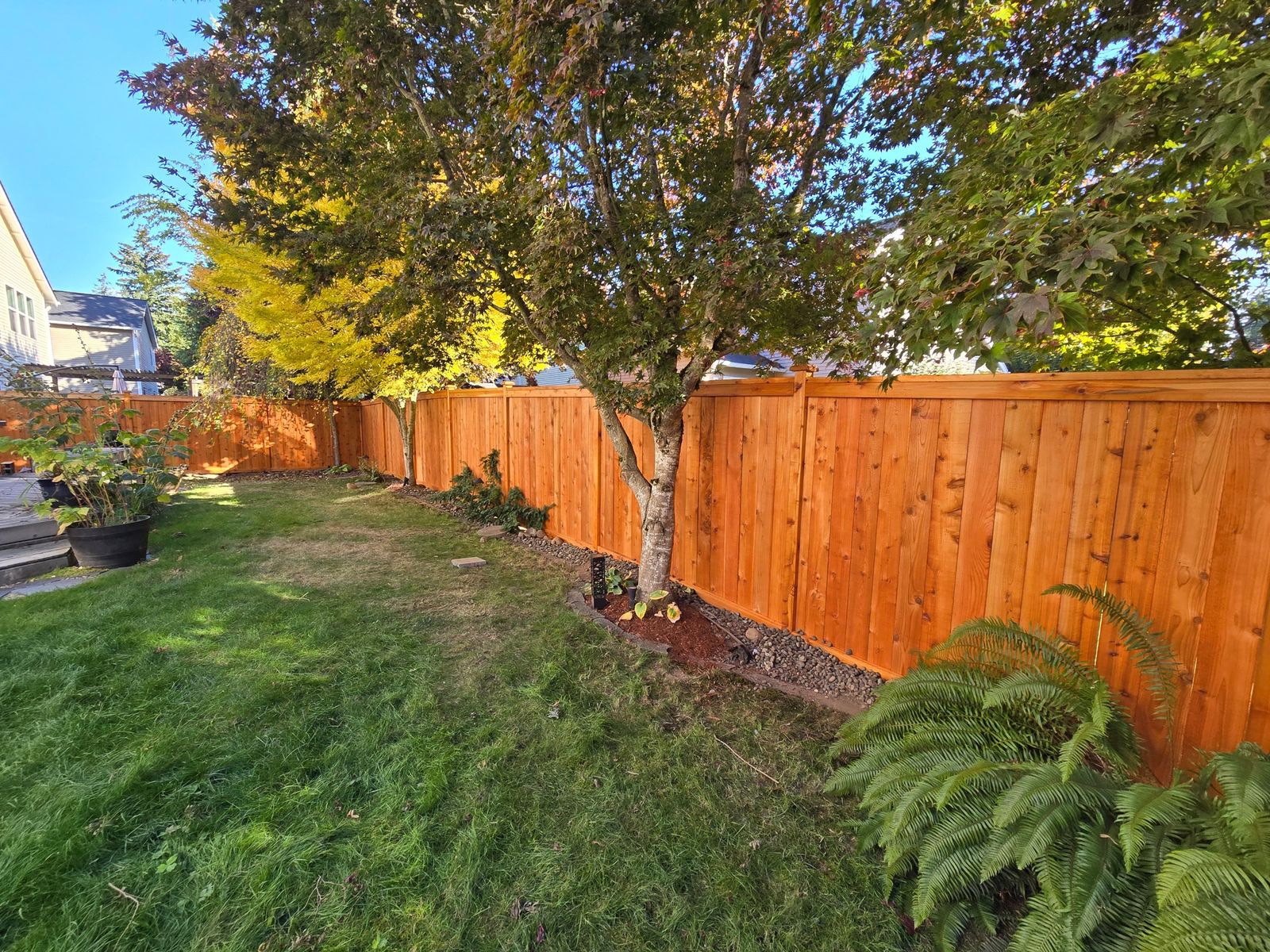
A Maple Valley yard where the fence runs behind a young maple and a bed of ferns.
For more on styles and heights, see our privacy fence guide.
Local examples: Mirrormont, Central Houghton and East Hill
Wooded lots look different across our service area. Our neighborhood pages go into the local details:
- Mirrormont, Issaquah: a forested community in the Tiger Mountain foothills, with larger lots, heavy canopy and steep ground. Before you design, read our Mirrormont HOA-approved fencing page and the association's architectural committee guidance.
- Central Houghton, Kirkland: mature trees and wooded edges near Watershed Park, plus Kirkland's limits on fencing in streams, wetlands, buffers and NGPEs.
- East Hill, Kent: established yards where our site assessment notes trees, slope and easements before we lay out the fence, and our crews work around roots on install day.
A wooded-lot fence checklist
| Step | What to do | Why |
|---|---|---|
| 1 | Walk the line and flag every trunk within reach of the fence | Plan jogs and gaps before posts are set |
| 2 | Check city or county rules, critical areas, buffers and easements | Some areas restrict fences or tree work |
| 3 | Check with your HOA's architectural review committee, if you have one | Many associations require approval before a fence goes in |
| 4 | Call 811 at least two business days ahead, and think about private lines | Required by state law; private lines aren't marked |
| 5 | Ask an arborist about any large tree close to the line | Root damage can take years to show |
| 6 | Choose clearance, post and finish options suited to shade | Shaded fences stay wet longer |
| 7 | Plan staging so materials don't sit on root zones | Compaction harms roots |
FAQ
How close can a fence post be to a tree?
There isn't one safe number. It depends on the tree's size, species and health, and on where its roots run. Iowa State Extension notes that most roots are in the top 6 to 18 inches of soil and can extend well past the dripline (source). For a large or valuable tree near the line, have an ISA Certified Arborist weigh in.
What if a post hole hits a big root?
Stop and move the post. Adjusting the bay width so the post lands elsewhere is usually better than cutting a large root. If the root can't be avoided, get an arborist's opinion before cutting.
Can I attach the fence to a tree?
We don't recommend it. Trees keep growing, and fasteners driven into a trunk wound the tree. Set a post next to the tree instead, and leave space for the trunk to grow.
Do I need to call 811 just for fence posts?
In most cases, yes. Washington's dig law exempts homeowners only when digging less than 12 inches on noncommercial property (WA UTC). Call at least two business days before digging (WA UTC).
Do I need a permit for a fence on a wooded lot?
It depends on your jurisdiction and what's on the property. In unincorporated King County, fences 6 feet or less don't need a building permit unless the property contains critical areas (King County). Cities have their own rules, so check with yours. We research the parcel as part of your estimate.
Will a fence under trees rot faster?
Shade and debris keep wood wet longer, and the USDA identifies moisture at the ground line as the main driver of decay (USDA FPL). Good ground clearance, a finish on every surface and regular clearing of debris all help. Our wood fence lifespan guide goes deeper.
Plan your wooded-lot fence with MyFence
MyFence builds pre-stained, pre-built cedar privacy fences across King County, from Issaquah and Kirkland to Kent and Covington. On your estimate, we'll walk the line with you, note every tree, and lay out a fence that works around them. Browse fence styles, then get a free quote or call (253) 455-1885.
Sources
- USDA Forest Products Laboratory (De Groot, Feist, Eslyn, Gjovik), Protecting Wood Fences for Yard and Garden, University of Wisconsin-Extension, 1979
- Iowa State University Extension and Outreach, How much space does a tree's root system need to grow properly?
- Iowa State University Extension and Outreach, Trees and Construction
- Washington Utilities and Transportation Commission, Call Before You Dig and Washington Dig Law for Realtors; RCW 19.122.030
- King County Permitting, Do you need a permit?
- City of Kirkland, Fence requirements handout
- Mirrormont Community Association, Architectural Committee FAQ
- The Seattle Times, How to keep your wood fence looking beautiful