
When Is the Best Time to Install a Wood Fence in Seattle? A Month-by-Month Puget Sound Guide
Can you install a cedar fence in a Seattle winter? A month-by-month look at Puget Sound rain, temperatures and wood moisture, what really limits wet-season fence work, and why shop pre-stained, pre-built cedar changes the answer.
Most "best time to install a fence" advice is written for places where the ground freezes solid and summers bake. Puget Sound is different. Our problem isn't frost or heat. It's water: months of steady rain, damp air and short, gray days. This guide uses real climate data for the Seattle area to show what actually limits fence work in each season. It also explains why a pre-stained, pre-built cedar privacy fence changes the answer to "should I wait until spring?"

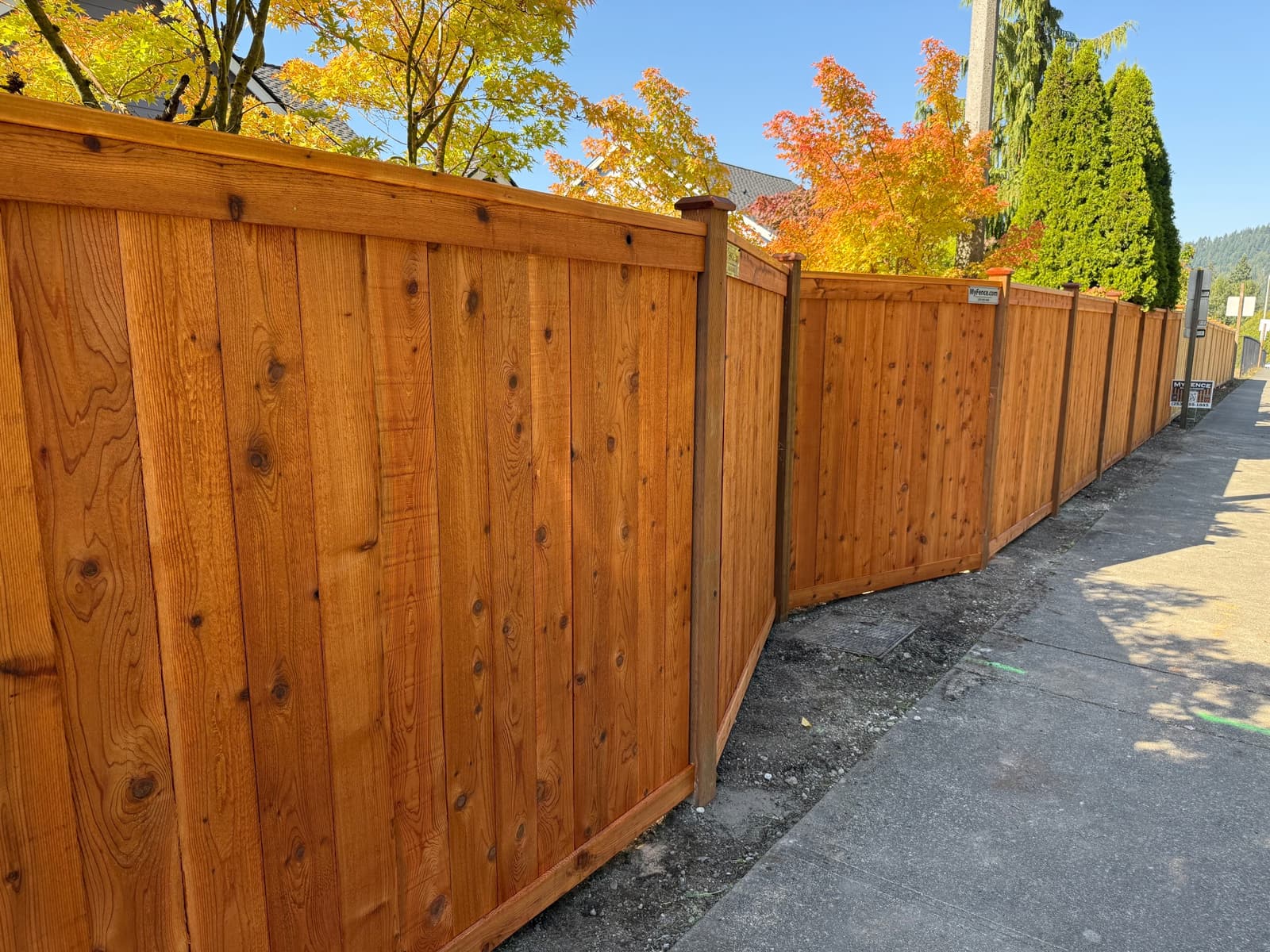
A MyFence cedar picture frame fence in Renton, photographed with fall color still on the trees.
In this guide
The short answer
If you want the driest weather, late spring through early fall is the easiest stretch for any outdoor project around Seattle. July and August are the driest months on record at Sea-Tac.
But "driest" isn't the same as "only." Light rain on its own doesn't stop a well-run crew from setting posts and hanging panels. What wet months mainly make hard is putting a finish on raw wood outdoors. When the boards arrive already dried and stained on every side, and the panels are built in a shop, most of that problem goes away.
The bottom line
For a cedar privacy fence, the season matters most if the wood will be stained on site after it's built. If it arrives pre-stained and pre-built, the main wet-season limits are things like heavy downpours, standing water in post holes and short daylight, and those usually cost days on the schedule, not quality.
Why Seattle's calendar is different
Generic guides from Chicago, New England or the Midwest tell you to avoid winter because the ground freezes. NOAA's 1991–2020 climate normals for Seattle-Tacoma International Airport tell a different story (NOAA NCEI):
- Days that never get above freezing are rare. Sea-Tac averages about 1.1 days a year with a high of 32°F or lower.
- Freezing nights happen, but not often. It averages about 25 nights a year at or below 32°F, most of them in December and January.
- Rain is the real constraint. Sea-Tac averages 39.34 inches of precipitation a year, and November alone averages 6.31 inches, with measurable rain on about 18 days.
So around Puget Sound, the question isn't "is the ground frozen?" It's "how wet is it, and what does that do to the wood and the finish?"
Your yard isn't the airport
These numbers come from one weather station at Sea-Tac. Lots up on the Sammamish Plateau, in the Cascade foothills or right on the water can be cooler, wetter or windier. Use the table as a guide to the pattern, not a forecast for your street.
Month by month: the numbers
Here's what an average year looks like at Sea-Tac. The first four columns are NOAA's 1991–2020 normals (NOAA NCEI). The last column is the average outdoor equilibrium moisture content of wood in Seattle from the USDA Wood Handbook: roughly the moisture level that wood kept out of the rain settles toward in that month's air (USDA Forest Products Laboratory, Wood Handbook, Table 13–1).
| Month | Avg. precipitation (in.) | Days with measurable rain | Avg. high (°F) | Days reaching 50°F | Wood moisture in outdoor air (%) |
|---|---|---|---|---|---|
| January | 5.78 | 18.7 | 48.0 | 11.7 | 16.3 |
| February | 3.76 | 15.9 | 50.3 | 13.1 | 14.9 |
| March | 4.17 | 17.1 | 54.2 | 23.0 | 14.4 |
| April | 3.18 | 15.0 | 59.3 | 28.3 | 13.6 |
| May | 1.88 | 11.3 | 66.3 | 30.9 | 12.9 |
| June | 1.45 | 9.2 | 71.1 | 30.0 | 12.8 |
| July | 0.60 | 4.7 | 77.4 | 31.0 | 12.0 |
| August | 0.97 | 4.9 | 77.6 | 31.0 | 12.4 |
| September | 1.61 | 8.3 | 71.6 | 30.0 | 13.4 |
| October | 3.91 | 14.3 | 60.5 | 30.1 | 15.7 |
| November | 6.31 | 18.4 | 52.1 | 19.0 | 16.6 |
| December | 5.72 | 18.4 | 47.0 | 8.5 | 16.9 |
How to read the table
- May through September is the dry, warm stretch. It's also when everyone else wants their fence built.
- October and April are shoulder months: wetter, but most days still reach 50°F.
- November through February is the true wet season. December averages only 8.5 days that reach 50°F, and wood in the outdoor air sits near its wettest point of the year.
Keep that 50°F column in mind. It matters a lot for staining, as you'll see below.
What wet weather really affects
Rain affects each stage of a fence project differently. Here's an honest breakdown.
Digging and setting posts
Post holes can be dug in wet soil. The issues are practical: muddy access across lawns, holes that collect water, and saturated ground on low corners and downhill lots. Ask any contractor how they handle standing water in a post hole and what the label on their post-setting product says about wet or cold conditions. A good crew will push a day rather than set posts in a flooded hole.
Whatever the season, Washington's dig law still applies. The Washington Utilities and Transportation Commission says to call 811 or request a locate online at least two business days before digging (WA UTC). The homeowner exemption only covers digging less than 12 inches on noncommercial property (WA UTC), and fence post holes are deeper than that.
Wood movement
Wood swells as it takes on moisture and shrinks as it dries. The Wood Handbook advises installing wood at the moisture content it will experience in service to keep dimensional changes after installation small (USDA FPL). Its Seattle figures range from about 12.0% in July to 16.9% in December.
In plain terms: boards that go up soaking wet will keep moving as they dry, and boards that go up bone dry in August will take on moisture in November. Wood that starts out dried to a moderate, controlled level, close to what it will see in our air, has less adjusting to do once it's on the fence.
Finishing
This is the big one, and it gets its own section.
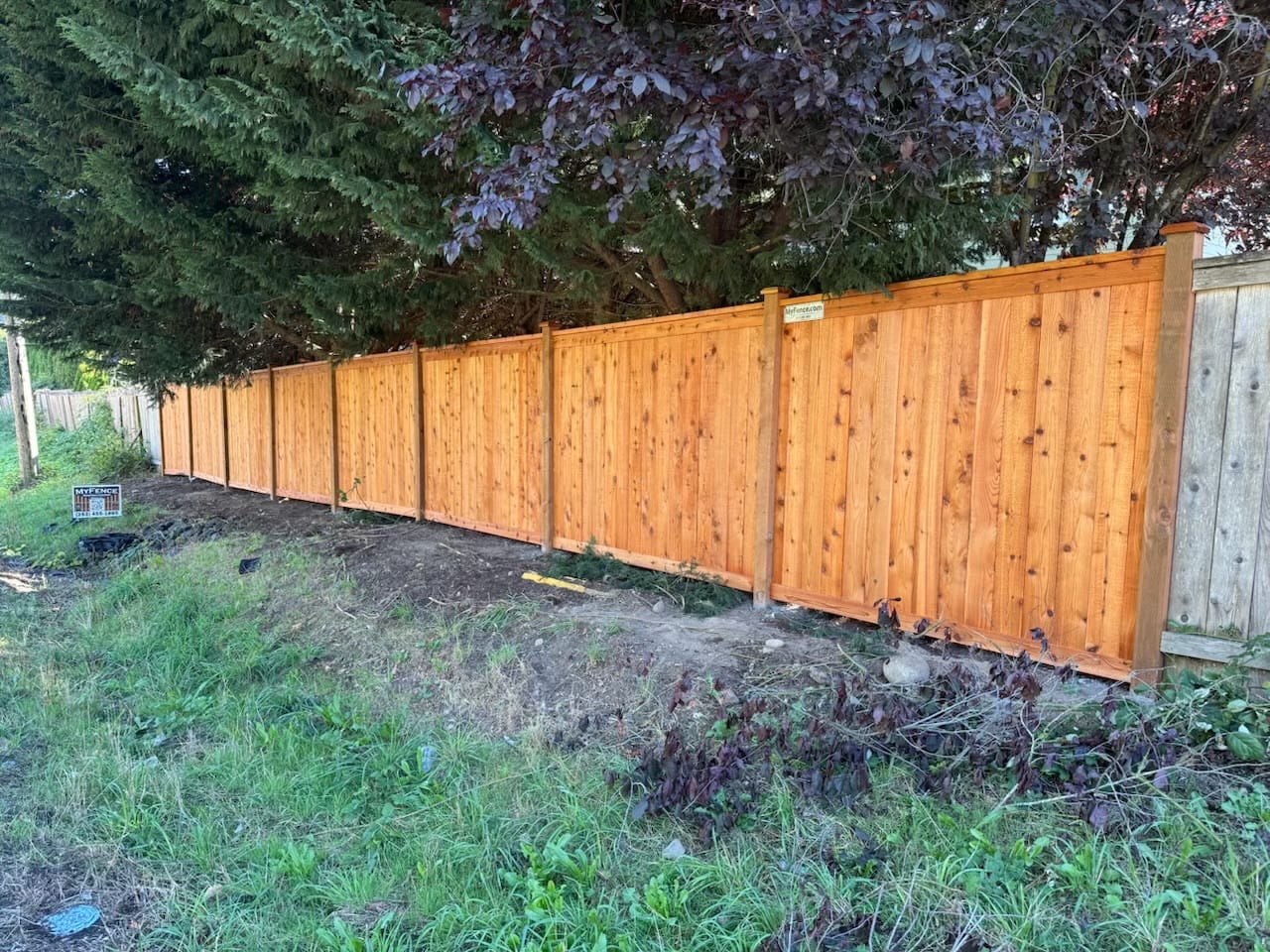
A long cedar run on a Renton job. On a fence this size, waiting for enough dry, warm days to stain on site can stretch for weeks in the wet season.
Why on-site staining is the real bottleneck
Every exterior stain has weather limits printed on its data sheet. They vary by product, so always follow the label for the one you use. Here are two examples from the same brand:
- Flood's semi-transparent alkyd/oil stain says to apply when no precipitation is expected for 24 hours, and when air and surface temperatures are 50°F to 90°F and will stay above 50°F for the next 24 hours (Flood product data sheet).
- Flood's semi-transparent acrylic/oil stain allows a lower range, down to 35°F. It still calls for no precipitation for 24 hours, and it warns that high humidity or temperatures below 50°F may prolong drying (Flood product data sheet).
Both labels also say the surface must be clean and dry before you start.
Now lay that over the Sea-Tac numbers. In December, the average month has measurable rain on about 18 days, and only about 8.5 days reach 50°F at all (NOAA NCEI). Finding a full 24-hour window that's dry, warm enough and comes after the boards have dried out is genuinely hard from November through February.
What that means for a raw-cedar fence built in winter
If raw cedar goes up in the wet season and the plan is to stain it on site, the finish usually has to wait. In the meantime the wood is exposed to months of rain. And even when you do stain, the back of the boards, the faces that sit against rails and the cut ends are hard or impossible to reach once the fence is assembled.
That last point matters in any season. The USDA Forest Products Laboratory names decay as the main cause of fence post failure, and says decay fungi need moisture to grow (USDA FPL, Protecting Wood Fences for Yard and Garden). Gaps in the finish are where water gets in.
How pre-stained, pre-built cedar changes the answer
MyFence moves the weather-sensitive steps indoors. As described on our pre-staining page:
- Cedar is dried in a controlled shop environment to a 12–15% moisture content before staining. That's close to the range the Wood Handbook lists for Seattle's outdoor air through most of the year.
- Every uncut component is stained on all six sides, including the faces that end up hidden against rails and posts.
- The staining happens in the shop, so it doesn't depend on the forecast.
- Panels are built in the shop as well, so less work happens in the mud on install day.
On install day, the crew sets posts and hangs finished cedar. The fence goes up already protected. There's no wait for a dry spell before the first coat, and no unfinished boards sitting in the rain until spring.
Plan for drying time
Drying and pre-staining take time, and our pre-staining page notes 2–4 weeks of advance material purchasing. If you're aiming for a particular date, such as before a new puppy arrives or before spring, start the estimate early.
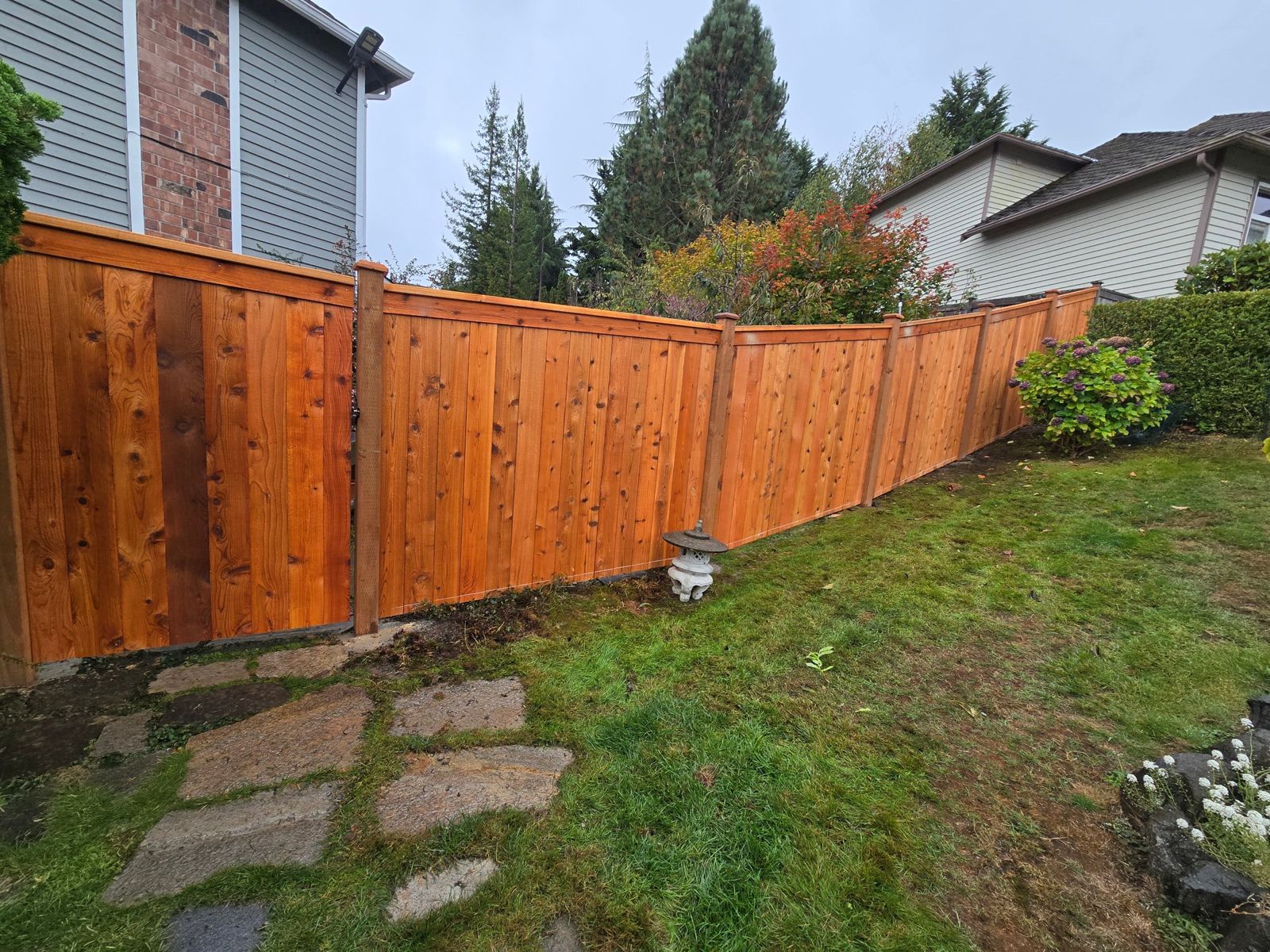
A modified picture frame cedar fence in Federal Way under typical gray Puget Sound skies.
Wet season vs. dry season at a glance
| Raw cedar, stained on site | Pre-stained, pre-built cedar | |
|---|---|---|
| Finish depends on dry, mild weather | Yes. Each coat needs a dry window on the label's terms | No. Stained in the shop before delivery |
| Hidden faces and board backs finished | Hard to reach after assembly | Stained on all six sides before assembly |
| Protection on day one | Not until it's stained | Yes |
| Wet-season scheduling | Build now, stain later, or wait for spring | Install when the ground and the forecast allow |
| Still affected by heavy rain and saturated ground | Yes | Yes |
We still reschedule for real downpours, flooded holes and unsafe conditions, and we say so plainly. MyFence works year-round when conditions permit. Pre-staining doesn't control the weather. It controls how much of the job depends on it.
Local examples: Ballard, Benson Hill and Beaver Lake
Wet-season conditions look different across our service area. Our neighborhood pages cover the local details:
- Ballard, Seattle: salt air off Shilshole Bay and damp from the locks and Salmon Bay. We keep soil off the first board and talk through hybrid options for the wettest corners.
- Benson Hill, Renton: county-era lots where winter rain runs downhill into the same low corner. We keep the bottom board out of standing water and hand-dig near roots.
- Beaver Lake, Sammamish: lakes that hold cool air and overnight damp longer than the surrounding plateau. We spec pre-stained Western Red Cedar and stainless or hot-dipped fasteners there.
If you're on a wooded lot, our guide to building a cedar privacy fence around big trees covers shade and moisture in more depth.
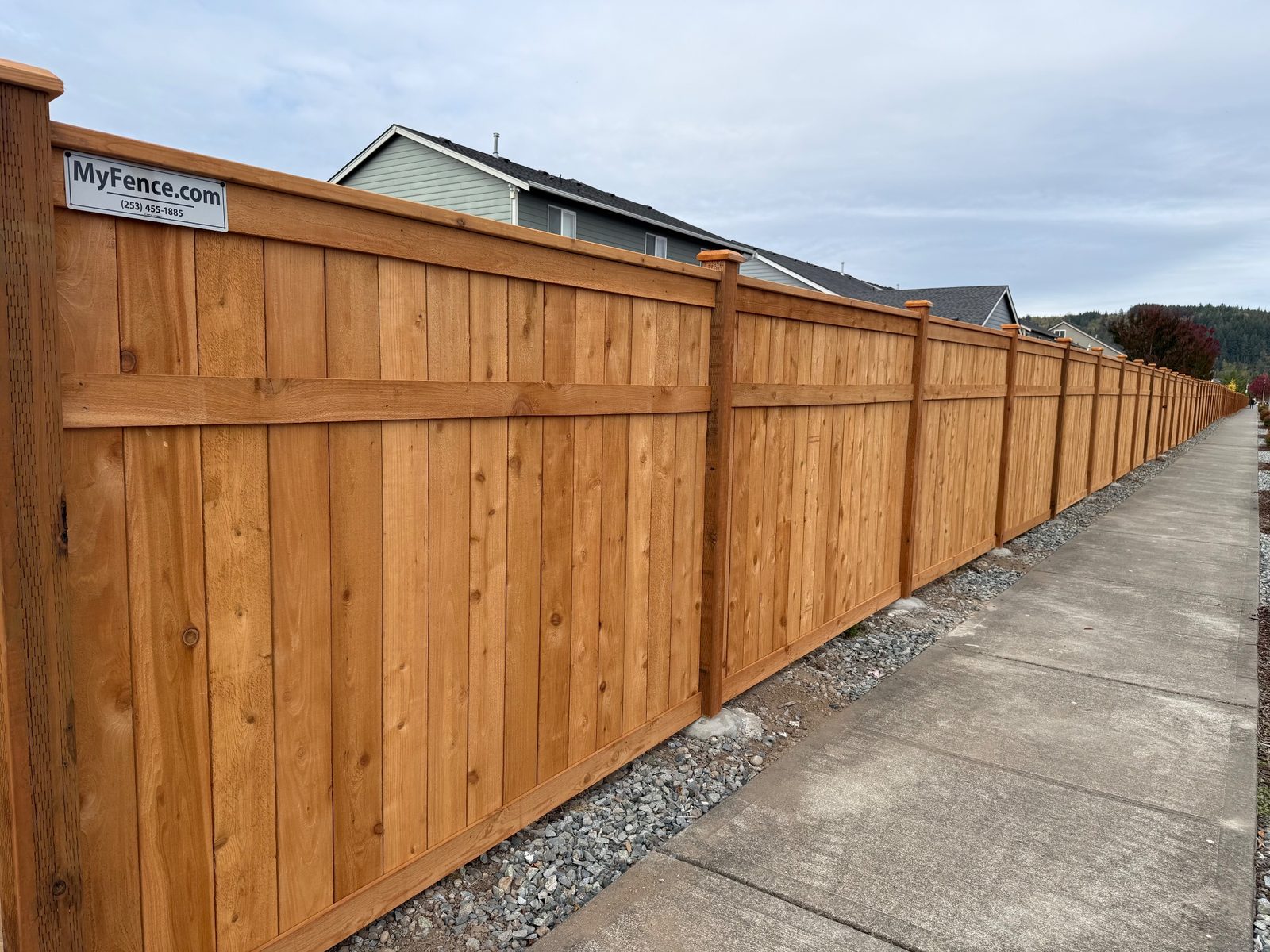
A 3-rail picture frame cedar fence along a sidewalk in Orting, Pierce County.
A season-by-season planning checklist
| When | What to do |
|---|---|
| Any time | Get an estimate, pick a style from our fence styles and privacy fence pages, and confirm your property lines |
| Before you commit | Check your city or county fence rules. If you have an HOA, check with its architectural review committee before you build |
| 2–4 weeks ahead | Allow time for shop drying and pre-staining of your materials |
| At least 2 business days before digging | Call 811 or request a locate online, and think about private lines that won't be marked |
| Install week (wet season) | Expect a possible day's shift for heavy rain or flooded holes. Clear a path for materials and keep pets inside |
| Install week (dry season) | Book early, since summer is the busiest time |
| After install | Keep soil, leaves and debris off the bottom of the fence, especially through fall and winter |
FAQ
Can you install a wood fence in the rain?
Light rain usually doesn't stop post setting or hanging panels. Heavy rain, flooded post holes and saturated, muddy access are different, and a careful contractor will move the date. What rain really limits is staining on site, because stain labels require a dry window, for example no precipitation for 24 hours (Flood).
Does the ground freeze in Seattle in winter?
Not often for long. At Sea-Tac, days that stay at or below freezing average about 1.1 a year, and nights at or below 32°F average about 25 a year (NOAA NCEI). Colder, higher spots can differ. In most Puget Sound yards, water is a bigger winter issue than frost.
What is the driest month to build a fence in Seattle?
July, with an average of 0.60 inches of precipitation and about 4.7 days of measurable rain at Sea-Tac, followed by August (NOAA NCEI).
Can I stain a new cedar fence in winter?
Only on days that meet your product's label: typically a clean, dry surface, a set temperature range, and no rain for 24 hours. In Seattle those days are scarce from November through February. Pre-staining in a shop avoids the problem.
Will a fence installed in winter last as long as one built in summer?
What decides how long a cedar fence lasts is mostly how it's built and protected: post details, ground contact, fasteners and finish. Our wood fence lifespan guide goes into it. A fence that goes up with every side already finished starts out protected, whatever month it's installed.
Is winter a cheaper time to install a fence?
This guide doesn't cover pricing, because it depends on your yard, layout and style. Your free quote is the best way to see the real number for your project.
Get on the schedule with MyFence
MyFence builds pre-stained, pre-built cedar privacy fences across King and Pierce counties, from Seattle and Renton to Sammamish. Whatever month it is, we'll walk your line, talk through timing honestly and get your materials drying and pre-stained so your fence goes up protected. Get a free quote or call (253) 455-1885.
Sources
- NOAA National Centers for Environmental Information, Summary of Monthly Normals 1991–2020, Seattle Tacoma Intl AP (USW00024233)
- USDA Forest Products Laboratory, Wood Handbook, Chapter 13: Drying and Control of Moisture Content and Dimensional Changes (FPL-GTR-282), Table 13–1
- USDA Forest Products Laboratory (De Groot, Feist, Eslyn, Gjovik), Protecting Wood Fences for Yard and Garden, University of Wisconsin-Extension, 1979
- Flood (PPG), Semi-Transparent Alkyd/Oil Stain product data sheet and Semi-Transparent Acrylic/Oil Stain product data sheet
- Washington Utilities and Transportation Commission, Call Before You Dig and Washington Dig Law for Realtors