
3-Rail Ranch Fence
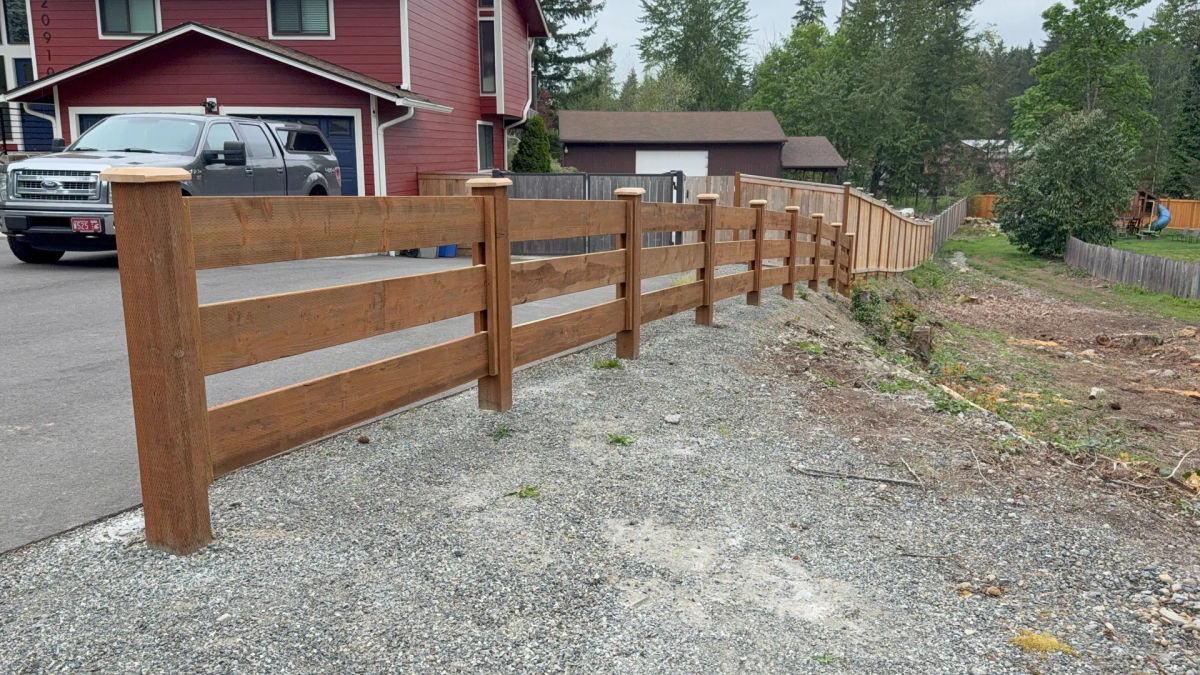
The 3-rail ranch fence — also known as post-and-rail or split-rail — uses 6x6 pressure treated posts with three pressure treated 2x8 horizontal rails between them. It's an open, intentional boundary that frames a driveway or property line without blocking views, light, or wind. A classic Northwest look with very little material between you and the landscape.
Why homeowners choose a 3-rail ranch fence
Open sightlines, intentional boundary
The fence reads as a clear property line without walling off the view. Ideal for front yards, driveways, and large lots where you want a defined edge without losing the landscape behind it.
Lets wind, light, and snow pass through
Open rails don't catch wind like a solid panel, so they hold up in exposed locations and don't drift snow against the fence the way a privacy fence will.
Handles sloped and uneven terrain well
Rails step or rack with the grade between posts, so a 3-rail line looks intentional on slopes that would force ugly stair-stepping on a picket-style fence.
Long-lived with minimal upkeep
Less material means less surface area to fail. Pressure treated 6x6 posts and 2x8 rails with proper footings and stainless steel hardware routinely deliver 15–25 years of service in Pacific Northwest weather.
How we build 3-rail ranch fences (our standard)
- 6x6 pressure treated fence posts set ~2' deep with ~180 lbs of properly mixed concrete and gravel drainage beneath each footing.
- Rounded post caps standard for a clean finished top that sheds water.
- Three pressure treated 2x8 horizontal rails attached to the inside face of the posts with structural screws or lag bolts — no nails.
- Even rail spacing top-to-bottom so the fence reads as intentional along the entire run.
- Stainless steel or hot-dipped galvanized fasteners throughout to prevent rust streaking down the lumber.
- Rails racked or stepped across slopes so the fence follows grade cleanly without awkward gaps under the bottom rail.
- Optional welded-wire or field-fence backing stapled to the inside face when you need pet, livestock, or poultry containment.
- Optional stain or sealant where requested so the finish is protected before the rails are installed.
Use our Virtual Quote Tool below for an instant estimate on your specific run.
Recent 3-rail ranch installations
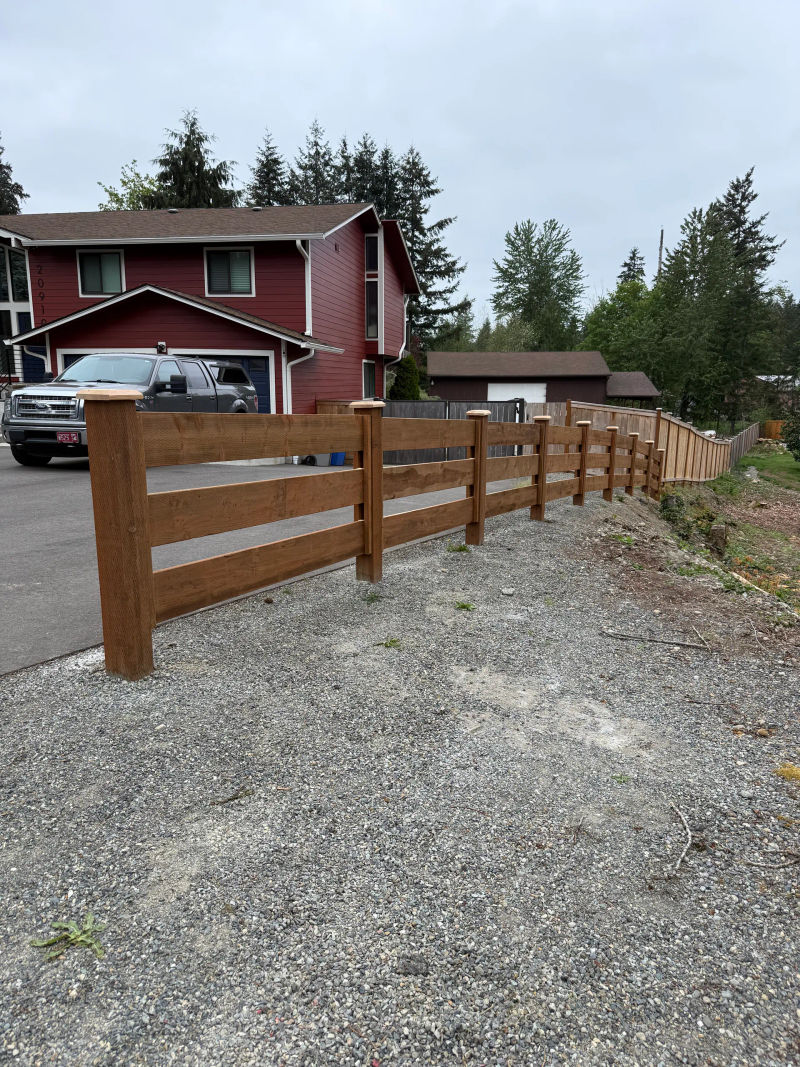
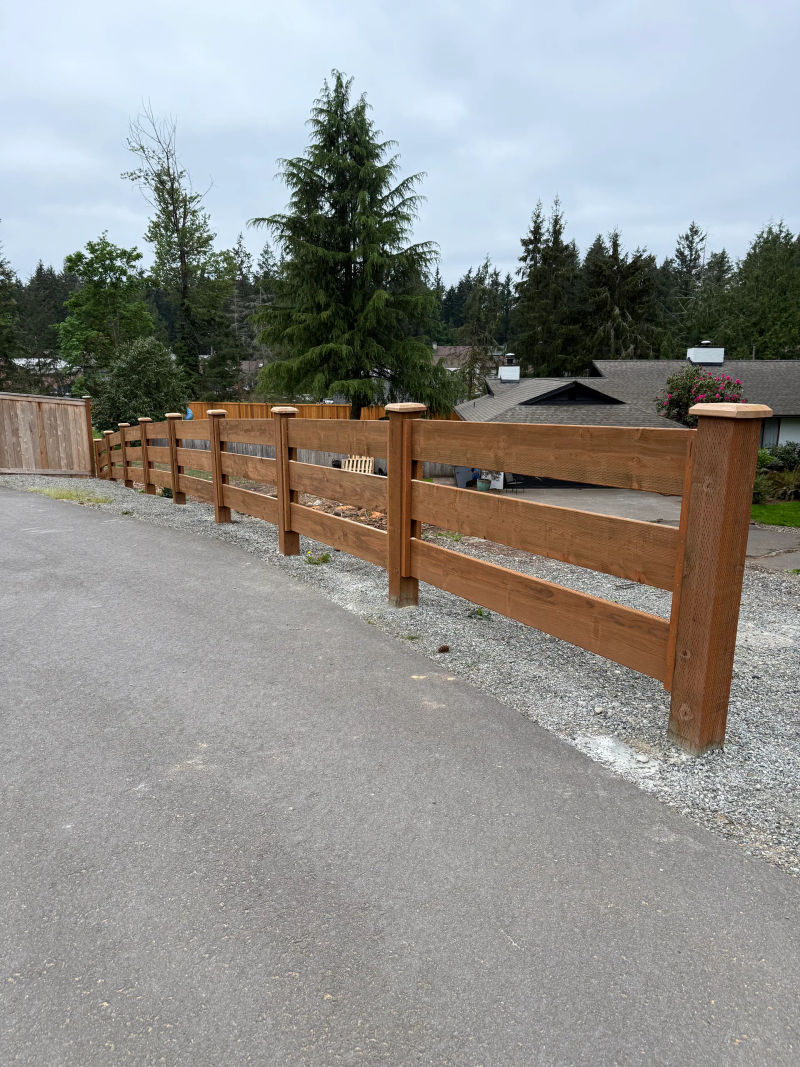
A recent ranch-fence installation in Kent, WA — three pressure treated 2x8 rails between 6x6 pressure treated posts with rounded caps, framing a driveway and property edge.
When 3-rail ranch is the right choice
Choose 3-rail ranch when:
- You want to define a property line, driveway, or pasture edge without walling off the view.
- Your lot is large and a privacy fence would feel oppressive or wall-like at the perimeter.
- The fence runs across noticeable grade changes that would look awkward with stair-stepped picket panels.
- You want a classic Northwest / ranch aesthetic with pressure treated posts, 2x8 rails, and rounded caps.
- You need optional pet or livestock containment (we add wire mesh to the inside of the rails).
Choose a different style when:
- You need privacy — see our Picture Frame, Shadow Box, or Solid Board styles.
- You want a refined, architectural picture frame look with three rails — see our 3 Rail Picture Frame Fence.
- You need secure containment for medium or large dogs without a wire backing — a picket or hogwire style is a better fit.
3-rail ranch fence pricing
3-rail ranch installations typically range from $28–$45 per linear foot depending on post size, rail dimensions, and site conditions. Because there are no pickets and less total material than a privacy fence, ranch fence is one of the most cost-effective ways to fence a long perimeter or driveway. Adding welded-wire backing for pet or livestock containment is an inexpensive upgrade.
Frequently asked questions
What is a 3-rail ranch fence?
An open-style fence built from 6x6 pressure treated posts with three pressure treated 2x8 horizontal rails between them. No pickets — the fence reads as a clean boundary without blocking sightlines, light, or wind.
What is it used for?
Property lines, driveway frames, pasture edges, and architectural front-yard boundaries on large lots. Decorative and territorial rather than secure — it doesn't provide privacy or pet containment on its own.
Can I add wire mesh for pets or livestock?
Yes. Welded-wire or galvanized field fence can be stapled to the inside face of the rails to contain dogs, small livestock, or poultry while preserving the timber look from the outside.
How does it handle slopes?
Very well. Rails rack or step between posts to follow grade cleanly, so the fence looks intentional on terrain that would force awkward stair-stepping on a picket fence.
How long does it last in the Pacific Northwest?
A properly built pressure treated ranch fence typically lasts 15–25 years, with the posts being the limiting factor. Rails sit above grade with airflow on both sides, so they dry quickly after rain.